


For over twenty years, Windows CE has been the foundation of numerous industrial solutions, from mobile terminals to embedded production systems. Today, with the definitive end of support by Microsoft – the last shutdown occurred in October 2023 – industrial managers, production managers, IT managers and QHSE managers are faced with an urgent question: what to do about the obsolescence of Windows CE? This change is not just a technical challenge; it also affects security, business continuity and the ability to innovate on your industrial sites. Here’s our analysis, based on over 30 years of supporting French industries in digital transformation and automated traceability.
Understanding Windows CE obsolescence: a breaking point for the industry
- Official end of service: As of October 2023, all major versions of Windows CE (including CE 6.0 and CE 2013) no longer receive patches or support.
- End of OEM license sales: Even if some licenses are sold until 2028, there is no longer any guarantee of security or technical support.
- A still massive presence: Many industrial lines and critical equipment, from RFID terminals to embedded PCs, still run on Windows CE in France.
Concrete industrial safety risks
- Increased vulnerability: without patches, every undetected vulnerability becomes an open door to attacks (ransomware, network compromise). It is no longer possible to guarantee the integrity of industrial information systems.
- Regulatory non-compliance: ISO, RGPD or GxP requirements call for an up-to-date infrastructure. Operating an obsolete OS exposes you to audit risks and sanctions.
- Cascading effects: Attacks threaten not only IT systems, but also automated business processes (production, logistics, quality).
Maintenance challenges: availability, costs and skills
- Parts and skills shortages: Manufacturers stop production or support for Windows CE-only equipment. Repair becomes costly, if not impossible.
- Additional intervention costs: The absence of editor support means that interventions have to be carried out on a case-by-case basis, with increased dependence on rare experts.
- Software complexity: Custom applications developed under Windows CE are difficult to migrate or upgrade. Incidents become chronic.
Blocking evolution and holding back digital transformation
- Software incompatibility: Impossible to run modern traceability, mobility or industrial AI solutions on Windows CE.
- Integration difficulties: New IS architectures (API, cloud, ERP, WMS, MeS) are not compatible with Windows CE equipment, putting automation and data management projects on hold.
- Under-exploitation of vision, RFID and RTLS solutions: Investing in the latest technologies is pointless without a compatible software base.
Warning indicators in your industrial park
- Older Windows CE equipment (>7 years) or equipment that cannot be migrated to Android/Windows 10 IoT.
- Increasing failure of software updates and rising incident rates.
- Switch off manufacturer media (PDAs, scanners, printers, etc.).
- IS projects postponed or cancelled for lack of application compatibility.
Choices for safe modernization: proven alternatives
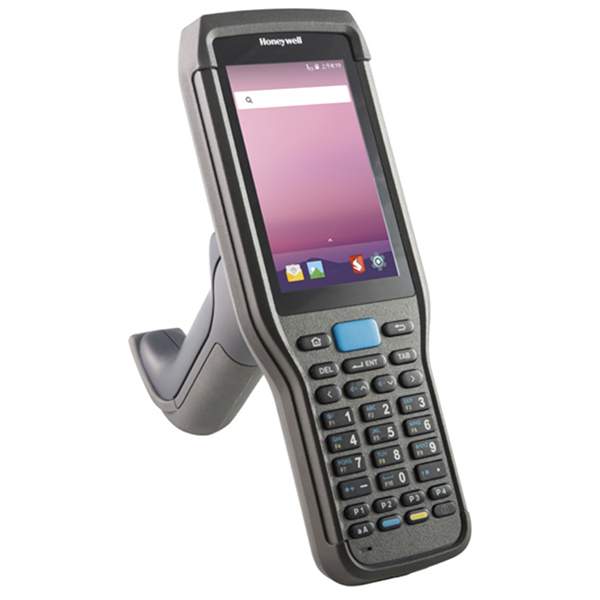
- Industrial Android: now the leader in logistics and data collection terminals. For example, the Honeywell EDA60K and EDA61K offer migration, robustness and maximum connectivity for logistics and distribution.
-

Honeywell EDA60K - Windows 10 IoT/Embedded: an industry-compatible platform that can be interfaced with modern ERP/WMS/MES systems. Supported until 2031 depending on model, it enables secure, scalable migration.
- Embedded Linux: For customized automation solutions in constrained environments.
Our approach: secure, migrate and enhance your industrial applications
- Complete audit and mapping of Windows CE installed base.
- Risk analysis: safety, compliance, operational maintenance.
- Iterative pilot phases to test and secure migration.
- Prototyping, acceptance, deployment in the field without interrupting operations. Examples: migration of mobile traceability terminals, rationalization of spare parts stock, adaptation of business applications.
- Support for training, documentation and long-term proactive maintenance.
We systematically propose a gradual transition, with dual fleet management (old and new) if necessary to guarantee operational continuity and risk control.
Illustrations of successful industrial developments at CIPAM
- RFID traceability modernization: Upgrade from old CE readers to modern RFID systems, such as the Datalogic DLR-BT001, which can be perfectly interfaced with Android or Windows 10 IoT for logistics management and connected maintenance.
- Replacement of industrial printers: Deployment of models such as Honeywell’s Compact4 Mark II for fast, reliable barcode and RFID printing, compatible with new generations of middleware and seamless logistics flows.
- Ultra-resistant RFID solutions for identification in extreme environments: Use labels like Ultra Resistant X-Bolt to guarantee traceability and durability on modernized equipment.
Frequently asked questions about the post-Windows CE transition
- Is it possible to maintain the security of a Windows CE installed base after 2023? No, publisher support has been discontinued and no new patches are available. Any additional cost or security action will remain limited in time and at a significant additional cost.
- Do you have to replace everything, or can you migrate gradually? Most successful projects are carried out in stages, equipment by equipment, with critical applications maintained during the changeover.
- What ROI can you expect from migration? In addition to compliance and new-found security productivity gains regularly reach +30 to +40%, while maintenance costs drop as early as the second year.
Accelerating the transition: key methodology for a controlled migration
- Mapping: Identify the entire Windows CE installed base and assess the degree of obsolescence of each device.
- Pilot: Implement a prototype of a new solution in a restricted functional area (e.g. production line, logistics area).
- Gradual production rollout: Deploy new terminals, readers, printers and applications in a planned way, switching over workflows at each stage.
- Training and support: transferring skills and documenting usage to minimize operational risk.
- Support and continuous improvement: Implement proactive maintenance with supervision tools (incident alert, remote patching, software version management).
Anticipate today, to secure tomorrow: our advice
Faced with these challenges, it’s better to anticipate migration rather than undergo it. Investing in the modernization of your industrial applications is not just an IT project, it’s a question of security, compliance and competitiveness. Each site is unique: we adapt our approach to your environment – audit, prototyping, testing, integration, training.
And don’t forget to keep abreast of key technological advances that are transforming maintenance, quality control and inventory management.
Conclusion: modernizing your plant means securing your industrial future
The transition to the post-Windows CE era is not inevitable. It’s an opportunity to accelerate towards a connected, agile and safe industry. Our support goes beyond simple migration: we help you transform your processes for optimum performance, enhanced compliance and efficient asset management.
For a customized analysis or to start a pilot project, discover our expertise and contact our teams directly.
We support you from the security audit to on-site integration, right through to ongoing maintenance of your new industrial environments.
For a customized analysis or to start a pilot project, discover our expertise and contact our teams directly.
We support you from security audits to on-site integration, right through to ongoing maintenance of your new industrial environments.