



In 2025, connecting RFID traceability solutions to ERP, WMS and MES systems is no longer just a technological asset, it has become the backbone of the digital transformation of industrial and logistics sites. This article offers a concrete vision – based on our experience in the field at CIPAM – of the benefits, key steps and best practices for building a solid, interoperable architecture for agile, sustainable traceability 4.0.
Why connect RFID, ERP, WMS, MES?
There are many strategic issues at stake for logistics, methods, QHSE and industrial managers:
- Real-time visibility of all flows: reception, production, storage, dispatch, maintenance… Nothing escapes automated traceability.
- Automatic synchronization of information: avoid breaks, duplicates and errors thanks to data that is instantly transferred from the workshop to the back-office, and then on to the customer.
- Reduce manual data entry and transport disputes, by eliminating human re-entry.
- Compliance with standards and regulations: from pharmaceuticals to railways to SEVESO, digital tracking is becoming essential (see also our solutions for more details on the application of RFID in constrained environments).
How do you approach an RFID-ERP/WMS/MES integration project?
- On-site audit and mapping of your flows
At CIPAM, every project begins with an analysis of existing flows: which objects to trace (pallets, parts, tools, containers, etc.), which zones to set up (goods reception, picking, production, dispatch, stocks), which environmental or ATEX constraints. This diagnosis enables us to anticipate the real complexities of the actual flow. - Choosing the right RFID technology and tags
The key is to adapt the type of RFID (long-range UHF, HF/NFC for proximity, ruggedness, metal, temperature…). For example, a rugged tag provides the necessary resistance for bins on logistics lines under extreme stress. - Installation and field configuration
This includes fixed readers(RFID tunnels for shipping control, gantries, PLCs, labeling robots) or mobile terminals. Implementation depends on infrastructure (gates, lines, docks) and the nature of flows (mass or unit).
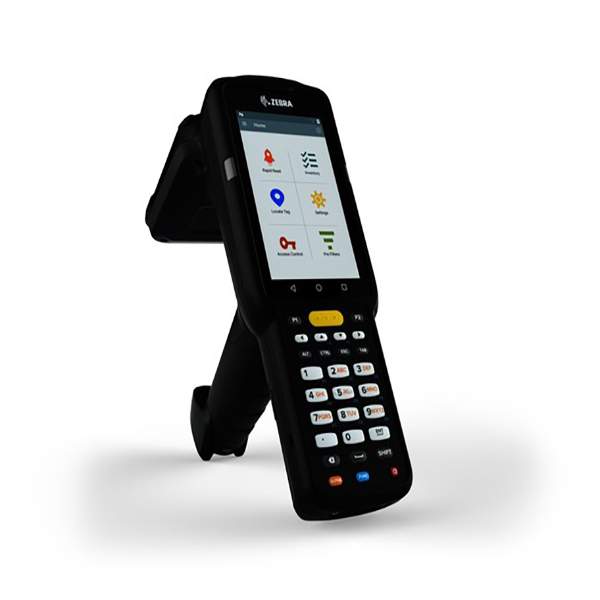
A lightweight terminal like the Zebra MC3330R speeds up inventories and enables any tag to be entered, thanks to ergonomics designed for field operations.
MC3330R Zebra - Software integration and IS interfacing
We give priority to the creation of connectors or APIs (REST/SOAP, webservices, dedicated mapping) between the RFID solution and your business IS (WMS, ERP, MES, CMMS, etc.).
This “middleware” layer guarantees the dynamic transformation of RFID information into data that can be immediately used by your internal applications, while providing secure flows and exception management (controls, alerts, etc.). - Pilot deployment, training and change management
A successful RFID traceability project doesn’t stop at the technical side: it includes training operators, carrying out real on-site tests, and setting up educational scenarios to guarantee adoption and performance. - Maintenance, follow-up and adaptive evolution
CIPAM supports its customers with proactive after-sales service (deadline commitment, parts inventory, hot-line), corrective and evolutionary maintenance. Our teams ensure continuous adaptability to your new business and regulatory needs.
Typical architecture: from field to ERP, a continuous digital chain
- Level 1: RFID field collection (tunnels, portable/mobile readers, adapted tags, PLCs/robots)
- Level 2: middleware connector (transfer database, verifications, business rules, risk or non-compliance alerts)
- Level 3: Business IS (Instant WMS updates: available stocks, picking, end of process – ERP: orders, inventories, purchasing, analytical management – MES: production, quality, compliance, OEE)
- Level 4: reporting and steering (dashboards, alerts, consolidated vision, decision-making reporting)
Concrete applications and operational benefits
- RFID tunnel shipment control: grouped control in less than 1 second, elimination of human error, speeding up transport disputes(see our dedicated article with feedback from the field).
- Automated management of returnable/reusable containers : complete life-cycle tracking, automatic stock-taking, unique identification, 30% reduction in industrial container losses.
- Traceability control under constraints (SEVESO, Pharma, aeronautics): systematic recording, digital proof for regulatory compliance, access management and flow security.
- Rail traceability (ID Rail) automatic high-speed reading, ERP/MES synchronization, partner interoperability.
Zoom: Best practices and points to watch for success
- Robustness of equipment: IP65/IP68 readers, tags adapted to the substrate (metal, plastic, cardboard, temperature, chemical, ATEX…) are preferable.
- Precise parameterization of antennas and zones: incorrect configuration impacts the read rate, and therefore the reliability of the entire automation system.
- Software interoperability: precisely map the business fields between RFID and the IS, and anticipate exception management with the integrator.
- Cybersecurity, auditing, access rights: an interoperable chain requires continuous monitoring (encrypted protocols, access management, auditing, digital traceability).
- Real-time supervision & reporting: tablets, dashboards, alerts, ROI analysis: really measure time savings, available savings, increased reliability, and adapt business settings on the fly.

FAQ – Industrial RFID integration in 2025 (what you need to know)
- Is RFID/ERP integration available in OPEX mode to limit investment? Yes, CIPAM offers flexible leasing/subscription and financing formulas, to accelerate return on investment and digitize the site as soon as the first operational gains are made.
- Can we start with a limited pilot before a full rollout? Absolutely, it’s recommended. It’s common practice to test the solution on a pilot workshop/logistics site before extending it to the whole site.
- Can RFID be integrated with existing machines/tools? Yes, thanks to multi-protocol interfaces, APIs and connectors, there’s no need to replace existing equipment. The aim is to enhance the value of existing equipment and complete business data.
For which sectors? Examples of areas where RFID integration is essential
- Heavy industry, metallurgy, energy, petrochemicals, environment – where robustness, safety and regulatory compliance are key.
- Automotive, rail, aeronautics – logistical complexity, batch traceability, documentary compliance.
- Health, pharma, medical devices – legal requirements and auditability.
- Transport, logistics, distribution – rapid flows, pooling, optimization of space and preparation cycles.
Tailor-made architecture, support and continuous evolution
At CIPAM, we believe that the success of an RFID integration project hinges on the ability to adapt to the customer’s environment: site size, heterogeneous IS, regulatory requirements, corporate culture. We favor scalable, modular architectures, with ongoing training, on-site support, and an active role as a long-term partner (rather than just a one-off supplier).
For further information: useful resources & in-depth studies
- Would you like to choose the right mobile terminal for field collection? See our article: How to choose the ideal industrial mobile terminal
- Feel free to explore our guide to choosing the right RFID reader to optimize industrial inventory management.
- To automate the logistics capital, our article on warehouse automation details the winning technologies of 2025
Conclusion: successfully transform, optimize ROI
Connecting an RFID solution to your ERP, WMS or MES systems is no longer an option, but a competitive lever for any company seeking to guarantee productivity, compliance and total control of its logistics and industrial information chain. The benefits are felt not only in terms of service quality, compliance and the reduction of hidden costs, but also in terms of organizational flexibility and day-to-day ease of use for employees.
Our experience with hundreds of sites deployed all over France and Europe has taught us the value of customization, listening to the business, and the ability to make solutions evolve with needs every year.
If it's visibility, performance or continuous improvement you're after - let's talk.
Contact us for a customized audit, an on-site pilot, or to discuss best practices in IS, RFID and business process integration.