



Shipment validation
RFID pallet control by RFID reader: make your pallets more reliable, reduce disputes
A palletizing error (wrong part number, missing carton, incorrect batch, forbidden mix) is rarely paid for at the time it occurs. It’s paid for later: disputes, returns, rework, delays, sometimes penalties and loss of confidence.
RFID palletization control via RFID reader secures this critical point without heavy infrastructure: the operator checks the pallet by RFID reading, compares it with the expected content (order, OF, SSCC, batch), and validates (or triggers a correction) before dispatch.
The solution works for your organization:
- RFID labels on cartons/packages (“shipping” identification),
- RFID tags on reusable containers (lifecycle identification),
- or mix (cartons + bins) on the same stream.
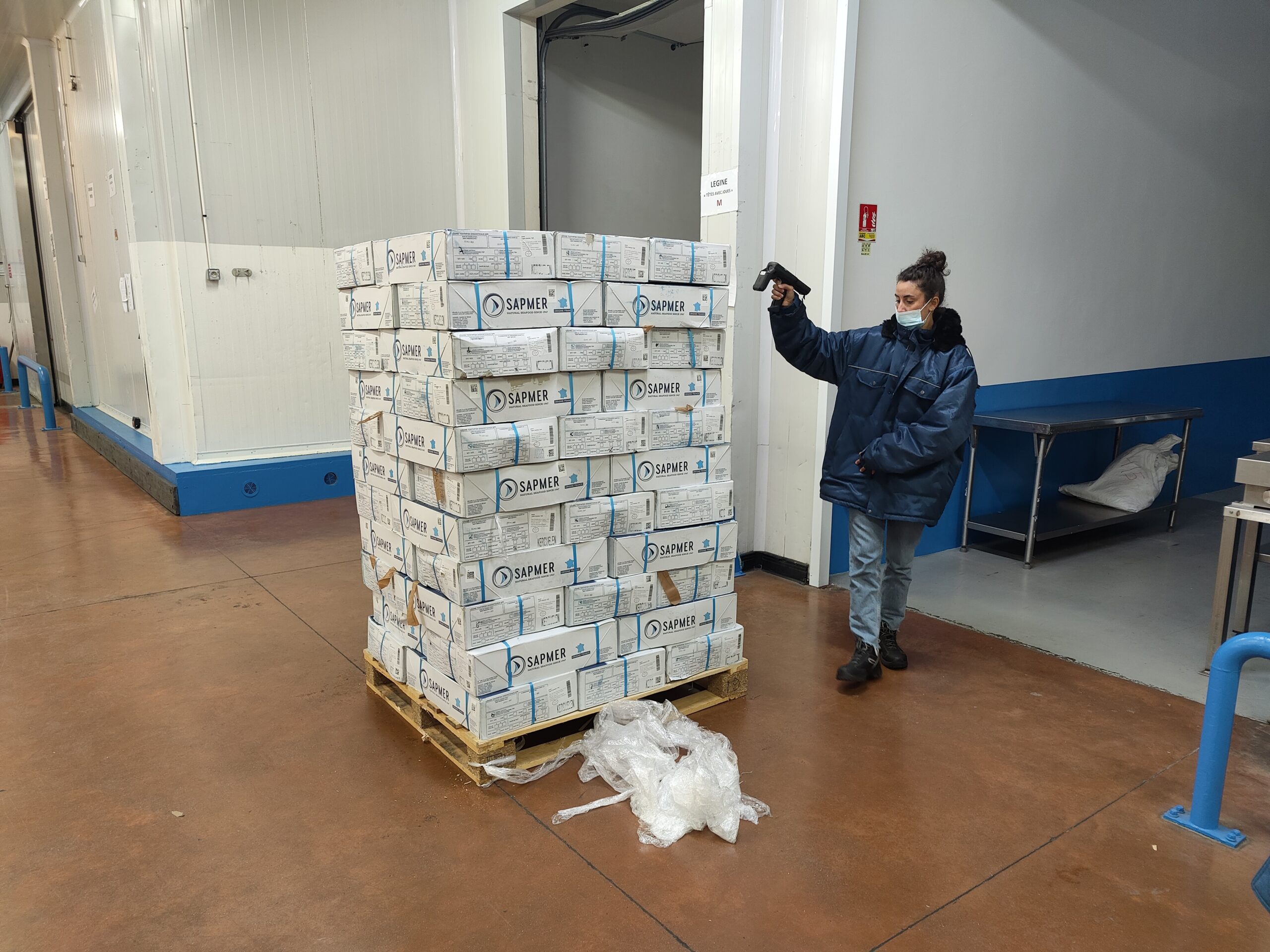
At CIPAM, the solution combines RFID reader (including portable RFID reader depending on context), application and business rules (“expected vs. read”, exceptions), time-stamped proof, and WMS/ERP/MES integration.
Flows, palletization rules, WMS/ERP integration, ROI estimates… let’s talk about your context.
See our global approach : RFID traceability
“The CIPAM solution has given us 100% accuracy in the volumes we load for export. No more anomalies concerning the number of cartons loaded. Significant time savings in our obligation to transmit information to our customers: details of batch numbers, dates, etc. It also means less stress for our teams, less pressure to carry out very time-consuming operations with a high risk of error within very tight deadlines. “
Josselin Moisan, Logistics Manager – SAPMER
In 30 seconds: why RFID palletizing checks with an RFID reader
- Guided compliance: “expected vs. read” comparison thanks to RFID reading, without unit scanning.
- Proof: time-stamped and historical events (quality, audits, disputes).
- Labels or tags: cartons/packets, bins/containers – or a mix depending on your flows.
Key benefits
- Savings: 100% compliance of pallets delivered
- Time savings : 90% compared to manual barcode inspection operations
- Quality : customer satisfaction and 100% stock reliability
- Reducing shift fatigue
Technical specifications
- Printers + RFID tags / labels
- PDA
- Dedicated web services for ERP communication
- Scalable mobile solution
Rates & financing
– Equipment price: from €20,000 ex VAT
– CIPAM leasing: from €410 ex VAT / month *
– Installation + configuration + training package included
*Yourapplication is subject to acceptance by our financial partner.
What's the point of RFID palletization control (really)?
RFID palletizing control is used to detect and correct errors before they leave the site. It secures :
- pallet composition (references, quantities, batches, mixing rules),
- shipment reliability (fewer disputes),
- stock/WMS consistency (fewer discrepancies),
- proof (audit, quality, customer relations).
The value does not come from the RFID reading itself. The value comes from the decision and the proof: pallet compliant / non-compliant / to be re-checked, with time-stamped event and IS integration.
How RFID palletizing control works with the "expected vs. read" RFID reader
The principle: expected (WMS/ERP) vs. read (RFID reader), then decision + proof + IS update.
1) Define expectations (order, SSCC, batches, mixing rules)
Expected data comes from the WMS/ERP: order, preparation, SSCC, parcel/picking list, batches. It can also include business rules: prohibitions, compatibilities, thresholds, customer conditions.
2) Identify: RFID tags, RFID tags… or mix
Two strategies (or a mix) depending on your constraints:
Option A – RFID labels on cartons/packages
Suitable for shipping/receiving, preparation and consolidation flows. The RFID ID is associated with the business object (parcel, order, batch, SSCC).
👉 RFID hardware
👉 RFID printers
Option B – RFID tags on reusable bins/containers
Suitable for long cycles (bins/shuttle/crates). Robustness in the field, useful for tracking rotations and availability.
👉 RFID equipment
Option C – Mix of cartons + bins
Useful when a pallet mixes reusable bins and cartons, or when the bin is identified as “support” and the carton as “contents”.
3) Read pallet with RFID reader (sightless, multi-item reading)
The RFID reader performs a quick scan around the pallet, without aiming. Depending on your production rates, control can be :
- guided (zone-by-zone reading),
- or simplified (global reading + rereading if necessary).
In certain contexts, a portable RFID reader makes it easier to operate at the dock or in preparation areas without a fixed installation.
4) Reliable reading (filtering, deduplication, thresholds, exceptions)
CIPAM application/middleware makes :
- filtering / deduplication,
- reading windows,
- confidence levels,
- exception rules (proofreading requested, additional checks).
5) Compare, decide, prove (OK / deviation / correction)
The system compares “expected vs. read” and produces :
- OK: pallet conforms (validation)
- Discrepancy: missing / extra / wrong batch / prohibited mixture
- Action: correction requested, proofreading, blocking depending on criticality
- Proof: time-stamped and historized event
6) Integrate with IS (business events)
The best practice is to report events to the WMS/ERP/MES:
- compliant pallet,
- non-conforming pallet + reason,
- status (pending / re-checked / validated),
- time-stamped proof.
Use cases: where RFID readers add the most value
Pre-shipment (quayside): securing what actually leaves
- quick check before loading,
- fewer disputes and returns,
- time-stamped proof usable on the customer’s side.
Internal transfers: making movements and status more reliable
- pre-stock control / workshop transfer / cross-dock,
- statuses updated in WMS/ERP without re-entry,
- reducing gaps and search time.
Multi-SKU / multi-lots: reducing silent errors
- mixing rules and compatibility,
- detection of inconsistencies (prohibited batch, missing SKU),
- exceptions managed: alert, correction, proofreading.
ROI, proof and results: what RFID palletization means in practice
The ROI of an RFID palletization check with an RFID reader is built on :
- errors avoided (disputes, rework, returns, penalties),
- reduced inspection time (RFID reading without aiming),
- reliable stock (consistent field/SI status).
Field results : SAPMER (export logistics)
- 100% accuracy on export loading volumes
- disappearance of anomalies in the number of cartons loaded
- time savings and stress reduction for teams
(Testimonial: Josselin Moisan, Logistics Manager)
Performance example (logistics / food processing)
- 100% conformity of delivered pallets
- 90% time saving vs. manual barcode inspection
- 100% stock reliability, customer satisfaction
- Reducing shift fatigue
Estimation of palletization ROI (volumes, error costs, throughput, IS integration)
FAQ : RFID palletizing control by RFID reader
RFID tags are often used on cartons/packets (encoding/printing, order/SSCC association). RFID tags are suitable for reusable containers (robustness, long cycle). A mix is possible depending on the nature of your flows.
This is a verification of the composition of a pallet via RFID reading, compared with the expected (order, SSCC, batches). The solution triggers an action (OK/alert/correction) and produces a time-stamped proof.
Barcodes have to be read individually, with aiming, and are highly dependent on gestures. RFID enables faster, sightless reading, and reduces forgetting and scanning errors.
Often yes, but performance depends on material density, tag placement and environment. A field POC validates the expected reliability.
Thanks to software rules: filtering, deduplication, reading windows, thresholds and exceptions (re-reading requested if necessary), plus operator gesture recommendations.
By reporting business events (compliant pallet, deviation, status, exception) via API or adapted exchanges, rather than raw readings.
A pilot can be launched quickly at the quay or on a critical flow, then extended according to ROI, sites and volumes.
Resources and useful links
- RFID traceability: https: //cipam.com/expertises/tracabilite-rfid/
- RFID products (tags/readers/antennas): https: //cipam.com/categorie-de-produit/rfid/
- RFID printers: https: //cipam.com/categorie-de-produit/imprimante-rfid/
- Data acquisition: https: //cipam.com/expertises/acquerir-les-donnees/
- IS integration: https: //cipam.com/expertises/integrer-vos-environnements-existants/
- Follow-up, support, maintenance: https: //cipam.com/expertises/suivre-accompagner-maintenir/