



RFID readers and antennas
From the “reading bubble” to the business event: designing reliable, reproducible and integrable reading.
Read the right thing, in the right place, at the right time
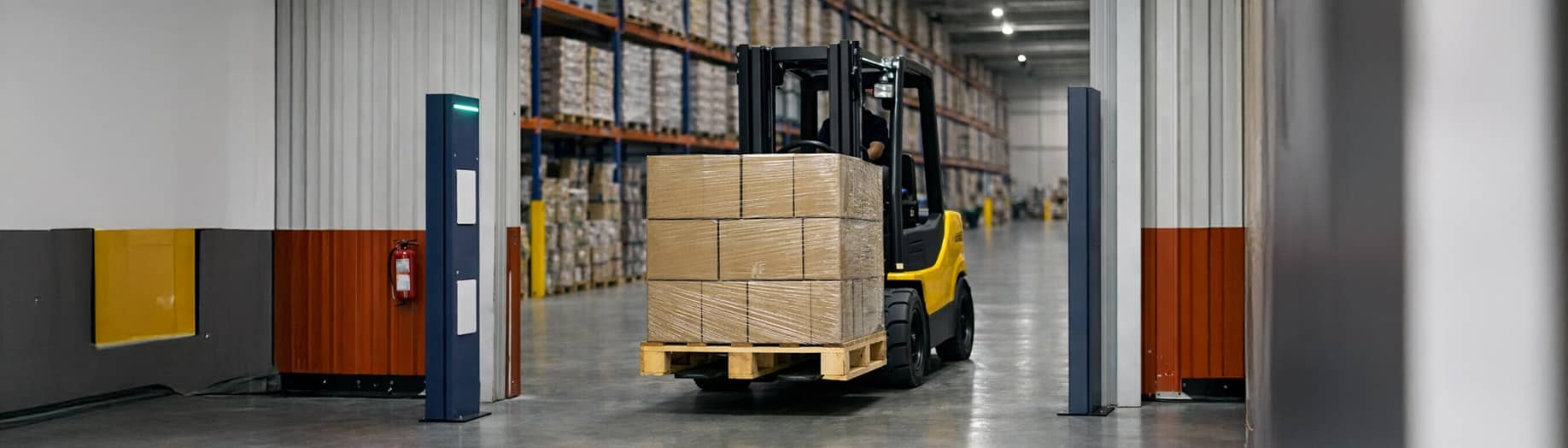
In an RFID (Radio Frequency Identification) project, the best results aren’t achieved by “turning up the power”, but by shaping the reading bubble. This electromagnetic volume, generated by the reader + antenna pair, must capture exactly what you’re expecting (a box in a tunnel, a tool at the station, a pallet under a gantry crane) and ignore the rest. Too wide, and you’ll get spurious readings and erroneous decisions. Too narrow, and it creates errors and manual reprocessing. This page will help you choose the reading architecture, select the antenna, set the EIRP (Equivalent Isotropically Radiated Power), order the trigger, and confine the zone to make the reading reliable, reproducible and integrable into your systems.

1) Choose architecture: fixed, smart, mobile or OEM
Good design starts with intelligence.
Fixed industrial readers. Mounted in tunnels, gantries or stations, they deliver stable power, manage several RF (Radio Frequency) ports and expose GPIOs (General Purpose Input/Output) for dialog with conveyors, light barriers and indicators. They are designed for high speeds and repeatability.
Smart readers (reader-controllers). They combine reader and local computation (Linux/Android). Advantages: buffering in the event of network outage, first local rules, autonomy of a cell (gantry) which only sends its own events to the system.
UHF (Ultra High Frequency) mobile terminals. Pistol or handle shape. Excellent for rotating inventories and directed search (signal-intensity guidance). They complement but do not replace a shipping tunnel.
OEM (Original Equipment Manufacturer) modules. To be integrated into special machines (label applicators, sorters). Compactness and latency are improved, and the machine fits neatly into the mechanics and cycle.
For end-to-end mechanics (reader → antenna → filtering → SI), see : How does an RFID system work?
2) RFID antennas: from lobe theory to workshop practice
Power isn’t everything. Beam geometry is decisive.
Polarization.
- Linear: high useful range if tag orientation is controlled.
- Circular: more tolerant of random orientations (tunnel/portico), slightly shorter range.
Radiation pattern. Each antenna has a main lobe and secondary lobes. In tunnels, the lobes are crossed to cover the orientations of stacked cardboard boxes. At the station, the beam is deliberately narrowed to read only the object presented.
Selection criteria. Target reading distance, lobe aperture, antenna gain, presence of metal/water, IP (Ingress Protection) ratings, mounting and wiring constraints.
Cables and losses. Losses increase with cable length and fineness. Choose short, high-quality cables (N-type, SMA, TNC connectors). Moving the drive closer to the antennas stabilizes performance and avoids the temptation to “inflate” power.
3) Set the bubble: power, time and filters
The right setting follows a precise sequence.
EIRP power (Equivalent Isotropically Radiated Power). Start high to validate coverage, then work your way down until you’re reading only the useful area. A bubble that’s too large complicates everything else (parasites).
Time windowing. Open reading only when the object is present: light barrier, cell, conveyor top via GPIO. Set dwell time to actual speed; it should be enough to read all tags without encouraging rereading.
Drive-side filters.
- EPC (Electronic Product Code) masks: only expected families are read.
- RSSI (Received Signal Strength Indicator) threshold: cuts off weak out-of-zone responses.
- Session/Q (UHF): limits rereading of the same tag during the window.
Physical containment. Absorbent screens, mechanical templates, antenna orientation: these are just some of the ways to give the reading bubble a clean edge.
4) Three implementation scenes, three reliability logics
Unit control station
Objective: precision. One or two antennas, tight lobe, minimum power. Ergonomics guides the operator (installation template, indicator light, beep). Middleware refuses several EPCs when only one is expected.
Shipping tunnel
Objective: completeness without pollution. Four to eight antennas (top/bottom/side) to cover orientations and stacking. Window synchronized to conveyor. Aggregation of readings and comparison withexpectations. Priority KPI: 100% package/pallet read, with no false positives from the neighboring line.
=>Discover the CIPAM RFID tunnel
Dock gantry / zone passage
Objective: reliable directional event. Directional antennas, entry/exit detection, confinement to the rear of the warehouse. Grouping by SSCC (Serial Shipping Container Code) and sending a clear event to the WMS (Warehouse Management System).
5) Working with materials and the environment
Metal reflects UHF;water absorbs it. Rather than struggle, design with these constraints in mind: on-metal tags, slight spacing if possible, adapted antenna orientation, RF shields to cut reflections. In humid environments, multiply tests, bring antennas closer together and consider HF (High Frequency) for proximity readings if UHF range is not required.
To choose the right labels (printable, hardened, on-metal), see : RFID tags
6) Integration: sensors, network and middleware
Reliable reading relies on clean integration.
- Sensors & I/O. GPIOs trigger the window; LEDs and beeps provide immediate operator feedback.
- Network. Ethernet/PoE, Wi-Fi or 4G/5G depending on site; ensure stability and prioritization of flows where necessary.
- Protocols. MQTT/AMQP for events, REST/GraphQL for queries, files if required by IS.
- RFID middleware. Filters, deduplicates, windows, applies compliance rules, aggregates (carton → pallet), logs (what, when, where, antenna) and pushes clean event to WMS, MES (Manufacturing Execution System) and ERP (Enterprise Resource Planning).
- Supervision. Player/antenna status, queues, latencies, alarms: this is the layer that prevents “flying on sight”.
7) Radio compliance: ETSI, FCC and power ratings
A high-performance setting must be compliant. In Europe, the ETSI (European Telecommunications Standards Institute) band regulates EIRP frequencies and power; in the Americas, it’s the FCC (Federal Communications Commission). Choose multi-region equipment, set up channels and document by site. Check for CE marking and compliance with the RED (Radio Equipment Directive).
For an overview of bands, ISO/IEC and GS1 standards, read : RFID frequencies and standards
8) Measure, monitor, improve: KPIs that count
- Read rate by scenario (desktop/tunnel/portal/mobile).
- False positives / false negatives, and their trend.
- Latency reading → decision → SI.
- RSSI (Received Signal Strength Indicator) stability over time.
- Hardware availability (failures, restarts), integration errors (API/files).
These indicators anchor your SLAs (Service Level Agreements), structure load ramp-up and guide micro-adjustments in the field.
9) Common pitfalls and quick fixes
- Power too high → bubble overflowing. Remedy: lower EIRP, add containment.
- Antenna misaligned → coverage holes. Remedy: review polarization and angle.
- Long cable/average quality → losses, instability. Remedy: shorten, improve connectors.
- No time window → duplicates in series. Remedy: sensor + calibrated dwell time.
- Bad tag for substrate → chronic underperformance. Remedy: on-metal on metal, compatible adhesive, on-site testing.
10) Ready-to-use POC (Proof of Concept) checklist
- Use cases: unit vs. mass, distance, flow.
- Band: UHF for ground/range reading; HF for proximity; LF (Low Frequency) for single cases in harsh environments.
- Reader: fixed/smart/mobile/OEM; number of RF, GPIO and power ports.
- Antennas: polarization, aperture, number, position.
- Cables: type, length, losses.
- Power: minimum per antenna for the lens.
- Window: sensor/conveyor, dwell time.
- Containment: screens, templates, orientation.
- Filters: EPC masks, RSSI threshold.
- Integration: middleware, WMS/MES/ERP connectors.
- Testing: on-site POC, documented KPIs, adjustment plan.

FAQ - RFID readers and antennas
How to avoid spurious line-edge readings?
Start by reducing the EIRP power to tighten the bubble. Aim an antenna at the right aperture, add RF screens if necessary, and trigger the reading via a synchronized time window (sensor/conveyor). EPC masks combined with an RSSI threshold complete the sanitization.
Linear or circular polarization: which to choose?
If tag orientation is controlled, linear polarization maximizes reach. If orientations vary (tunnel, gantry), circular polarization is more tolerant – even if it means slightly reducing the useful range.
How many antennas are needed for a high-performance shipping tunnel?
Usually 4 to 8 antennas arranged top/bottom/side. Success depends more on homogeneous coverage and windowing than on raw power.
Why does my set read “every other shot”?
It’s often a trio: tag orientation, nearby metal reflections, RF losses in the cable. Reposition the tag, reorient the antenna, check the cabling and recalibrate the power.
Can I share a reader between several antennas?
Yes, many readers support four RF ports (or even more via multiplexers). Make sure that the illumination time per antenna and the power available cover the actual throughput.