



RFID tags: presentation and definitions
An RFID (Radio Frequency Identification) tag is not just another consumable. It’s the identity sensor of your flow: it carries the identifier, resists your environment and “talks” correctly to the antennas. A label that performs well on cardboard may fail on metal or in a damp environment. This guide helps you to understand tag families, select the right reference, encode the identifier and validate under real-life conditions – for stable readings and robust traceability.
For an overview, see the article: RFID technology
1) The main RFID tag families and their uses
Label selection is based on three factors: substrate, environment and process.
1.1 Consumables (inlays and printable labels)
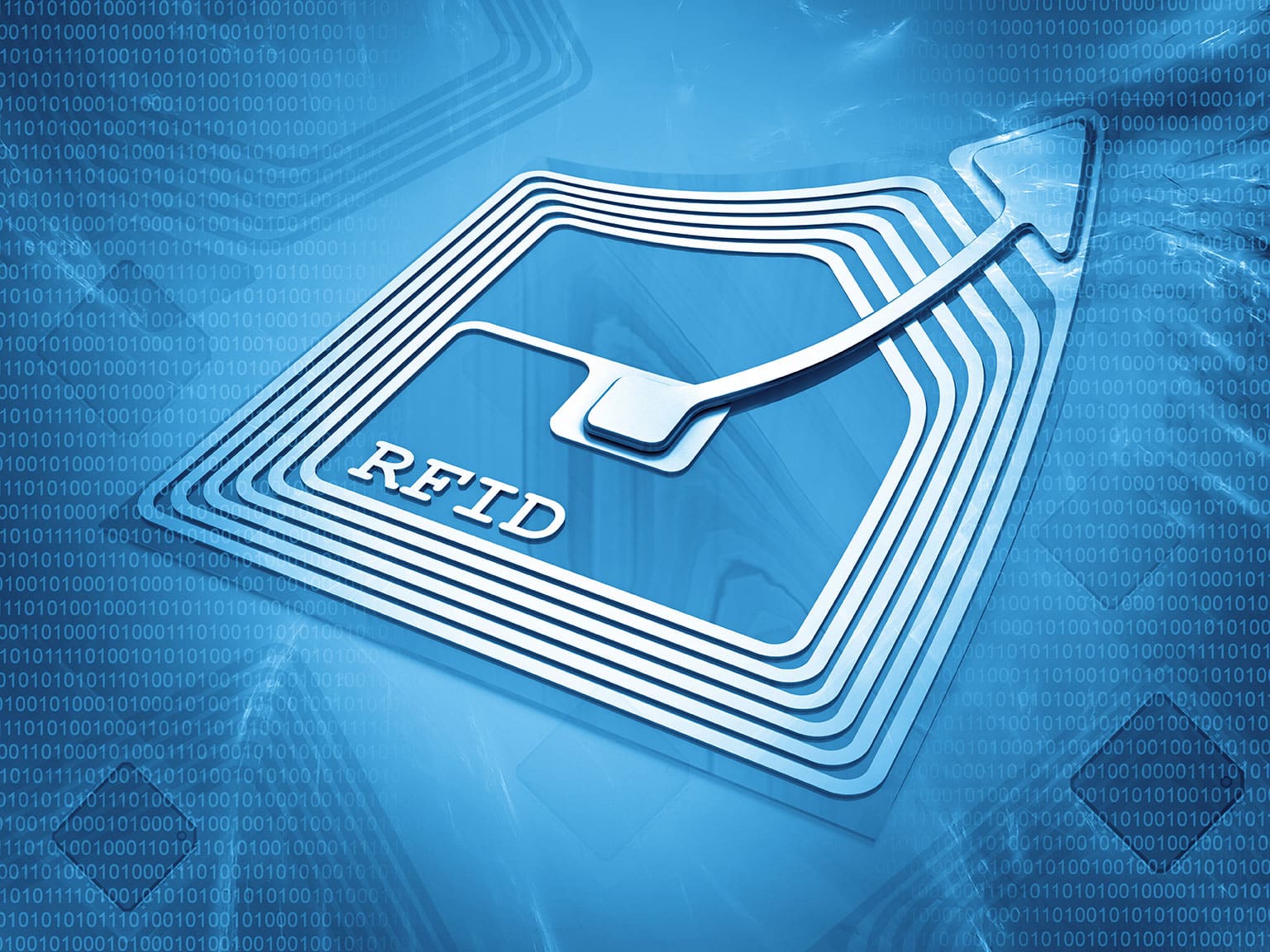
Ideal for cartons, files, clothing, non-metallic plastic parts. An inlay (antenna + chip) is integrated into a printable and encodable label.
Advantages: low unit cost, high print output, quick installation.
Points to watch: adhesive adapted to surfaces(PE, polyethylene / PP, polypropylene, painted steel, powder paint).
1.2 Hard tags (industrial tags)
Designed for harsh environments (heat, chemicals, shock, UV). ABS (acrylonitrile-butadiene-styrene) / PBT (polybutylene terephthalate ) / epoxy housings, high IP (Ingress Protection) ratings (IP67/IP68), fastening by rivet, screw, collar or technical adhesive.
Uses: reusable bins, racks, molds, tooling.
1.3 On-metal labels
Specific to metal surfaces. They incorporate an insulating layer or a tuned antenna to maintain UHF (Ultra High Frequency) performance on metal.
Formats: very thin (IT/tools) or thick (long range, shock).

1.4 Seals and safety labels
For securing containers, cupboards, drums and chests. Visible break when opened. Access traceability and “chain of custody”.
1.5 HF/NFC cards and key fobs
HF (High Frequency) at 13.56 MHz includes NFC (Near Field Communication). Ideal for access control, operator assignment and proximity interaction with a smartphone.
To place the tag in the complete chain (readers, antennas, rulers), read: How does an RFID system work?
2) Frequencies: LF, HF/NFC or UHF, what difference does the choice make?
Frequency determines range, mass reading and tolerance to the environment.
- LF (Low Frequency, 125-134 kHz): very short range, good performance in damp/metallic environments, single reading (e.g. access control).
- HF (High Frequency, 13.56 MHz, including NFC): short to medium range, reliable exchanges in close proximity, useful for operator/smartphone interactions.
- UHF (Ultra High Frequency, 860-960 MHz, also known as RAIN RFID): reading at several meters and en masse. Here,
RAIN (RAdio frequency IdentificatioN) refers to the ecosystem and industry standard around passive UHF (associations, usage profiles, interoperability). It is the logistics/industrial reference (flash inventories, shipping tunnels, gantries).
When it comes to radio regulations, remember the ETSI (European Telecommunications Standards Institute) zone in Europe and the FCC (Federal Communications Commission) zone in the USA. For basics and standards, see : RFID frequencies and standards.
3) What’s on your label: identifiers, memory and security
Each label includes at least :
- TID (Tag Identifier): read-only hardware identifier.
- EPC (Electronic Product Code): business identifier encoded in the chip.
Among the most widely used GS1 (Global Standards One) schemas:
- SGTIN (Serialized Global Trade Item Number): product serialized by unit.
- SSCC (Serial Shipping Container Code): logistics unit (pallet, parcel).
- GRAI (Global Returnable Asset Identifier): reusable container.
- GIAI (Global Individual Asset Identifier): individual asset/equipment.
- SGLN (Global Location Number): location (site, quay).
Some chips offer user memory (parameters, dates). Access can be password-protected, and a kill command can be used to deactivate the label if required.
EPC best practices: govern uniqueness (ranges per site/line), link EPC ↔ reference ↔ batch ↔ order, control encoding on printing. Detailed definition: see EPC in the RFID Technology pillar.
4) Support and environment: the key to performance
Label performance is first and foremost physical.
- Metal: reflects the UHF wave. Use on-metal, create distance (spacer), take care with orientation/posting.
- Liquids: water absorbsUHF. Multiply tests, optimize orientation/antennas; for near-unit reading, HF may be preferable.
- Temperature / washing / chemistry: autoclave, ovens, solvents, detergents. Choose high-temperature cures, validate chemical and UV resistance.
- Mechanical stress: impact, abrasion, dust, humidity. Select robust enclosures, compatible adhesives and suitable IP ratings.
5) Printing and encoding: reliability right from the start
Printable/encodable labels are processed in a single pass with an RFID printer: encoding of theEPC, verification then printing of the visual (text/codes).
Best practices :
- Failure control: retry, scrap, logging (zero “dumb tag”).
- Post-encoding proofreading: check EPC – visual association.
- Consumables: paper/PP(polypropylene)/PE(polyethylene)/PI(polyimide) and ribbons compatible with your substrates.
- Traceability: who printed/encoded what and when.
The RFID middleware (software layer) then transforms the reading into a business event and sends it to your systems. To find out more: RFID software solutions.
6) Selection method: how to choose the right label (field approach)
Selection takes place at your premises, on your media, at your pace.
- Qualify requirements: distance/span, flow rate, unit vs. mass reading, exposure (heat, water, chemical).
- Pre-select 3-5 references: standard for cardboard/plastic, on-metal for metal, hardened for severe cycles.
- Prototype in real-life conditions: measure read rates, false positives/false negatives, stability over the day/week; test orientation and location.
- Validate the supply chain: availability, MOQ (Minimum Order Quantity), multi-source alternatives, print quality/adhesion.
- Industrialize: approved tag repository, SOP (Standard Operating Procedure) for installation/encoding/control, recovery plan (reprint, re-encode).

7) Use case: ready-to-use tag baskets
Shipping & warehousing (UHF, mass reading)
- Cartons/pallets: labels printable + encodable with RFID printer.
- Tunnel: orientation-tolerant, mass-reading-validated references.
Production & WIP (Work-In-Progress)
- Reusable bins, racks, molds: on-metal hardened screwed/glued.
- Tooling: robust, compact mini on-metal.
Health & pharmaceuticals
- Sterilizable instruments: autoclave tags.
- Sensitive containers: chemical-compatible labels, wet testing.
Agro & beverages
- Drums/bottles: hardened tags or RFID seals; on-metal if required.
- High-speed lines: tunnel validation, performance on wet surfaces.
For inspiration by sector, see Using RFID in industry
8) Common mistakes to avoid (and how to correct them)
- Choose a “generic” tag with no real testing → random performance.
- Underestimate metal/water → reading rate collapses.
- Incorrect installation location: shadowing, twisting, rubbing.
- Adhesive unsuitable for material/environment → delamination.
- Absent EPC governance: duplication, reuse too early.
- Uncontrolled encoding: mute labels in production.
9) Costs and procurement: realistic orders of magnitude
- Inlays / UHF printables: a few tens of centimes depending on volume.
- On-metal / hardened: from 1 to a few euros depending on format and resistance.
- RFID seals: variable according to security/robustness level.
- HF/NFC cards: low unit cost, printable.
Optimize by standardizing 1-2 references per use, securing a second source and planning your consumables (white labels, ribbons, liners).
10) To find out more about RFID
A label only has value if its reading becomes a business event in your tools:
- Overview : RFID technology (pillar page).
- End-to-end mechanics: How does an RFID system work?
- Technical framework: RFID frequencies and standards.
- Software layer: RFID software: all solutions.
- Case study: RFID in industry.
Faq RFID tags
Our answers to the questions often asked by our customers
A dedicated on-metal label, with insulating layer or specific antenna. Test format and exact installation location.
Yes, but performance drops as water absorbsUHF (Ultra High Frequency). Multiply tests, adapt orientation/antennas; for close reading, HF (High Frequency) may be preferable.
Yes, for hard tags (bins, racks, tools). Printables are generally single-use.
Theinlay is the antenna + the chip. Theprintable adds support/adhesive for printing/encoding. The hardened encapsulates the whole in a sturdy case (workshop, outdoor), often in ABS (acrylonitrile-butadiene-styrene), PBT (polybutylene terephthalate) or epoxy resin.
Manage numbering (ranges per site/line), control encoding on print and log the EPC – reference – batch – order association.
Choose a material/environment-compatible adhesive (including PE, polyethylene / PP, polypropylene), prepare the surface (cleaning/degreasing), or switch to screw/riveted mounting if the environment is abrasive/wet.