


Zebra Industrial Printers — A CIPAM-Certified Partner for 30 Years
Linerless printers: print without a backing, reduce waste, and speed up your production lines
Zebra ZD421 and ZD621 linerless printers: Select, configure, and integrate your linerless printer with the support of an integrator with 30 years of expertise.

What is a linerless printer?
A standard label consists of three layers: the printable substrate, the adhesive, and the liner—that silicone-coated backing that is peeled off and discarded after application. This liner accounts for about 40 to 50% of the roll’s total weight, without providing any functional value.
A linerless label eliminates this backing layer. The adhesive is protected by a silicone coating applied directly to the top surface of the roll, which allows the labels to be wound without sticking to one another.
A linerless printer is a direct thermal printer equipped with a specialized cutting or tearing module and a platen roller coated with a non-stick coating to prevent adhesive buildup. The Zebra ZD421 and ZD621 models offer this option in a direct thermal configuration.
The Practical Benefits of Linerless Printing
📉 Economic Benefits
- Less material purchased: The liner accounts for 40 to 50% of the weight of a standard roll—you no longer have to pay for it
- Less storage space: For the same outer diameter, a linerless roll holds up to 50% more labels (Ravenwood Packaging)
- Less shipping: reduced volume and weight for the same number of labels
- Lower TCO over the long term despite a slightly higher unit cost per roll
⚡ Operating Income
- Fewer roll changes: 40–50% more labels per roll = fewer production line stoppages (TSC / Technavio 2026)
- No need to handle the liner: eliminates unnecessary movements and reduces the risk of slipping and accidents
- Consistent throughput on high-frequency pick/pack/ship lines
- Variable format on certain models: the label length is determined at the time of printing, not set in advance
🌱 Environmental Benefits
- −33% less waste sent to landfills compared to labels with a liner (2025 study)
- −35% reduction in the carbon footprint over the consumable’s entire life cycle
- −38% post-consumer waste (Beontag / Labels & Labeling)
- Compliance with European directives on packaging waste and CSR objectives
- Silicone-coated liner is one of the most difficult types of waste to recycle—less than 5% of the global volume is recycled or reused
What users observe in the field
The documented feedback from the industry points to the same conclusions.
At a logistics warehouse (Ravenwood Packaging, operational study): The switch to linerless packaging reduced the weight of the rolls by 40%, leading to a direct reduction in storage and transportation costs. Operators also noted a reduction in maintenance on the applicators, as the liner was the main cause of unrolling incidents.
On pick/pack/ship lines (TSC Auto ID, 2024 site): Eliminating the step of peeling off the liner significantly reduces the time per label at high throughput rates. On a line labeling 2,000 packages per day, the 0.5-second savings per label amounts to 16 minutes of operator time saved per day.
In the food service and retail sectors (Collamat, a European systems integrator): 50% increase in continuous uptime for applicators paired with the Zebra ZD421 linerless printer; no liner waste to manage on the production line.
Point to note: The printer’s platen roller may accumulate adhesive on its edges over time. Periodic cleaning (weekly or monthly, depending on usage) is necessary. CIPAM includes this item in its preventive maintenance contracts.
Zebra linerless printers available at CIPAM
Only Zebra direct thermal models support linerless media. Thermal transfer models (with ribbon) are not compatible because the ribbon cannot be used with linerless media.
Zebra ZD421 — linerless option
The Standard Choice — Compact, Reliable, Versatile
The ZD421, in its direct thermal configuration, is compatible with the linerless kit (tear-off or cutter). It is the most widely used linerless printer in logistics, distribution, and the food industry.
- Print width: up to 104 mm
- Resolution: 203 or 300 dpi
- Options: Linerless Tear-Off or Linerless Cutter (can be installed on-site)
- Speed: 152 mm/s
- USB, Ethernet, Wi-Fi, Bluetooth
- Compatible with ZPL, Link-OS, and Print DNA
- Variable format: label length defined at print time
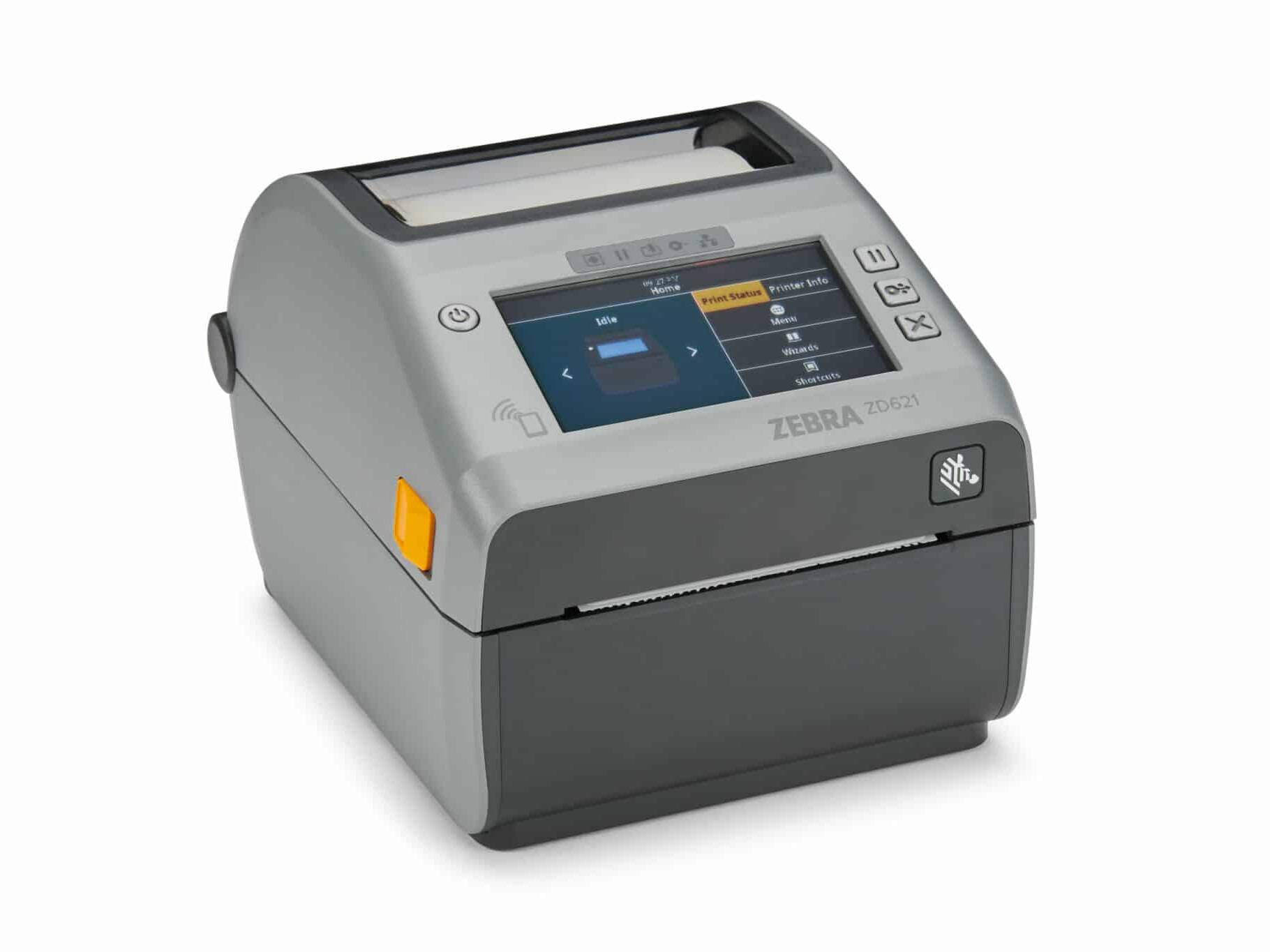
Zebra ZD621 — linerless option
The advanced version — touchscreen and higher cadence
The ZD621 Direct Thermal offers the same linerless options as the ZD421, plus a 4.3-inch color touchscreen and a higher print speed. Ideal for supervised workstations or high-frequency production lines.
- Print width: up to 104 mm
- Resolution: 203 or 300 dpi
- Options: Linerless Tear-Off or Linerless Cutter
- Speed: 203 mm/s
- 4.3-inch color touchscreen
- USB, Ethernet, Wi-Fi, Bluetooth
- ZBI 2.0, Link-OS, Print DNA
For which industries and applications?
🐟 Food and Beverage and Fresh Produce
Labeling of fresh products, best-by dates, and batch traceability. The linerless adhesive label withstands positive temperatures well. The variable length feature allows the label to be adapted to the product’s size without changing the roll format. HACCP compliance is facilitated by the absence of liner waste on the food production line.
🛒 Retail and Mass Merchandising
Price tags, promotions, and shelf labels. The variable length allows you to generate labels tailored to each product without changing the media. Visibly reduces in-store waste and enhances your brand’s CSR image.
📦 Logistics and e-commerce
Labeling of outbound packages, delivery slips, and return labels. High throughput on pick/pack/ship lines. Fewer roll changes = fewer stoppages = more packages processed per shift.
🏥 Food Service and Catering
Labeling of prepared meals, sandwiches, and food trays. Variable length is very useful for non-standard sizes. The Zebra portable linerless mobile printer allows for labeling directly in the kitchen or at the counter.
Choosing the Right Linerless Consumables
Linerless consumables are not interchangeable with conventional consumables—they require a specially treated substrate (with a silicone coating on the top side) and an adhesive formulated to prevent jamming in the winding mechanism.
The 3 selection criteria:
① Adhesive — Permanent, repositionable, food-grade (FDA/CE compliant), high-temperature, or freezer-safe. Linerless adhesive must also be compatible with your printer’s platen to prevent adhesive buildup.
② The substrate — Direct thermal paper for standard applications (logistics, retail, food service), synthetic polypropylene for humid environments or curved surfaces, and white film for demanding environments.
③ Format — Roll width compatible with your printer (57 mm, 80 mm, or 104 mm for the ZD421/ZD621). The length can vary within the limits of the configured model.
CIPAM offers a catalog of linerless consumables that have been qualified and tested on Zebra ZD421 and ZD621 printers. We conduct adhesion tests on your surfaces before making any commitments.
FAQ — Linerless Printers
A linerless printer is equipped with a cutting or tearing mechanism designed for substrates without a backing, and a non-stick platen roller. It uses only direct thermal media—no ribbon. A conventional printer cannot print on linerless material without risking damage to the mechanism.
Yes—under certain conditions. There are linerless UHF RFID substrates that combine the RFID inlay and the linerless backing. Compatibility with the printer’s RFID encoder must be verified based on the type of inlay and the antenna’s positioning. CIPAM can perform this compatibility test prior to deployment.
Yes—there are linerless adhesives formulated for positive cold temperatures (0°C to +8°C) and some for frozen surfaces. Selecting the right adhesive for your environment is critical. CIPAM conducts adhesion tests on your actual surfaces and packaging.
The platen roller of a linerless printer accumulates adhesive on its edges over time. Periodic cleaning with a cloth dampened with isopropyl alcohol is necessary (weekly or monthly, depending on usage). The platen itself has a service life comparable to that of other thermal printers. CIPAM includes this item in its preventive maintenance contracts.
Yes—that’s one of the key advantages of linerless labels. The label length is defined in the ZPL command sent to the printer; it is not determined by the roll. This means you can print labels of different lengths from the same roll, depending on the product being labeled.
The ZD421 in a linerless configuration (direct thermal + tear-off or cutter kit) starts at around 600–1,000 € excluding tax, depending on connectivity. The linerless ZD621 starts at around €1,000–1,400 excluding tax. Linerless kits (Tear-Off or Cutter) can be installed on-site. CIPAM offers framework agreements for multi-site fleets.
Let's talk about your linerless project
Model selection, testing of consumables on your surfaces, ERP/WMS integration—CIPAM supports you every step of the way.