


RFID Shipping Control: Eliminating Shipping Errors Right at the Loading Dock
The truck has just left the loading dock. Two hours later, the phone rings: a box is missing from pallet number three. Or worse, there’s an extra one—from another order, belonging to a customer who’s still waiting for their goods. The shipping manager pulls out the packing slips. He questions the forklift operator. He reviews the loading dock footage, if available. The dispute is opened. A credit memo is prepared. When faced with the sales department, it’s the warehouse that has to explain itself, even though the check could have been done automatically, in a matter of seconds, before the truck even left.
Request a demonstration of the RFID system at the loading dock
The Essentials
- Inspections at the dock are becoming automated. An RFID gate or tunnel reads an entire pallet in a single pass, without anyone having to scan a single box.
- The comparison is obvious. The system compares what is scanned with the shipping order and flags any discrepancies before loading.
- The malfunction is preventing takeoff. A red light or a visual warning stops the operator before the truck hits the road.
- The benefit extends throughout the entire chain. Fewer disputes, fewer credit notes, a more harmonious customer relationship, and full traceability for every shipment.
The True Cost of a Shipping Error
A shipping error is never limited to a missing box. It sets off a chain of consequences that often costs far more than the value of the goods in question.
The Dispute. A customer call, a complaint email, a case to open. We have to find the packing slip, check the video recordings when available, and piece together the facts—something that could have been done in an instant if the inspection had taken place at the right time.
The credit. Any dispute that goes undetected before shipment often results in a credit memo, a return of goods, or an urgent supplementary delivery. These unexpected logistics costs eat into an already tight margin.
The image. A customer who receives an incomplete or incorrect order twice will start looking for another supplier. Shipping reliability is one of the factors that quietly but consistently influence customer loyalty.
The weather. Troubleshooting an error involves the shipping manager, sometimes the team leader, and sometimes customer service. This time is never tracked anywhere, but it takes a toll every week on teams that are already under pressure.
The dock inspection that activates automatically
Quality control at the loading dock has always existed, in one form or another. It generally relies on an operator who checks packages by hand, scans one barcode at a time, or—worse yet—trusts the label affixed to the top of the box without checking what’s underneath. This manual inspection remains fallible because it depends on the operator’s alertness, fatigue, and the volume of packages to be processed at the end of the day.
“The shipping inspection is the final checkpoint before the goods leave the company. The more reliable the identification is at this stage, the easier it is to ensure the order is prepared correctly without adding unnecessary checks.” Jean-Luc — RFID Expert at CIPAM
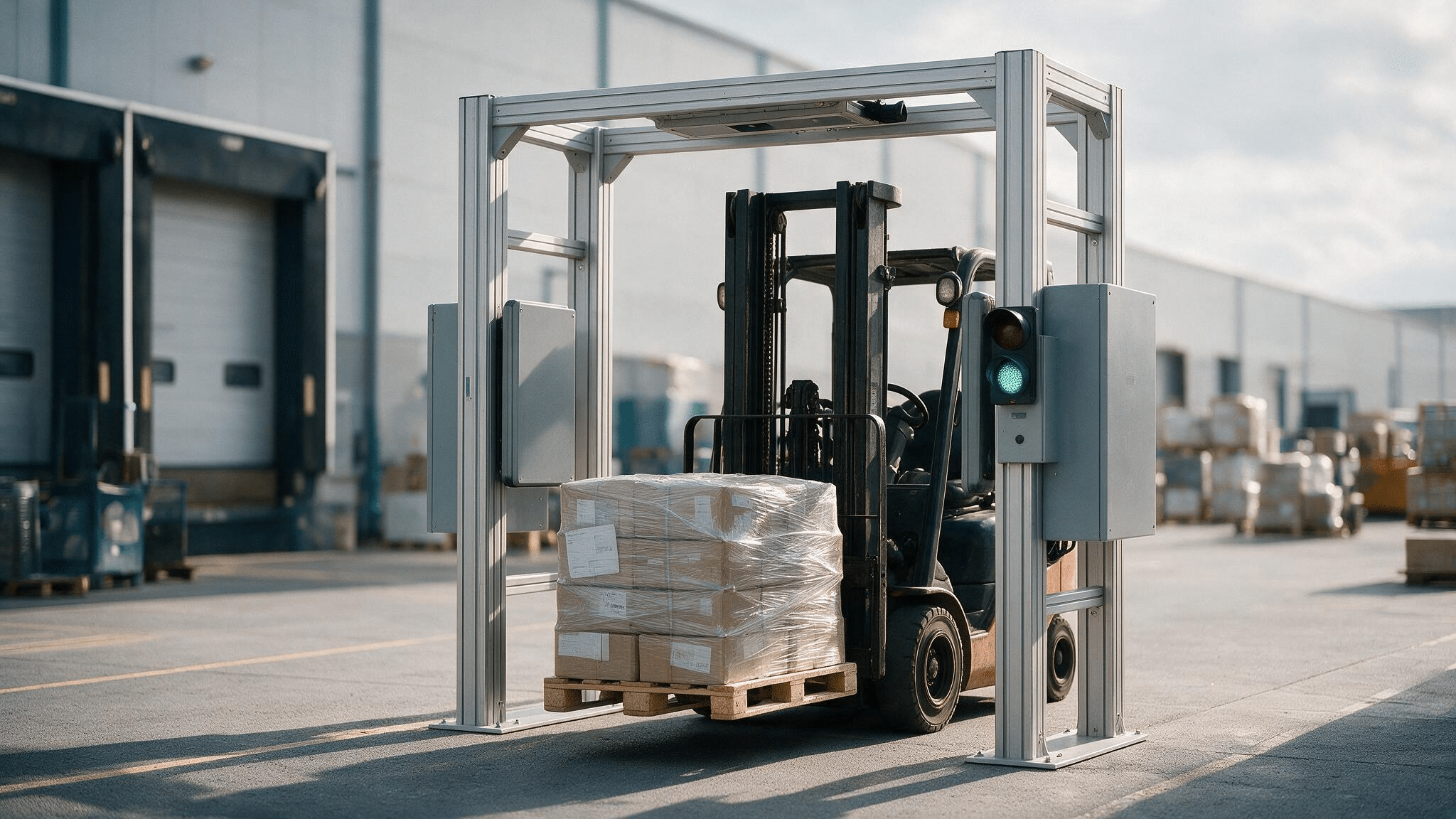
RFID is changing the very nature of this process. Every package and every logistics unit carries an RFID tag that is read at the UHF frequency of 865–868 MHz. An RFID gate or RFID tunnel installed at the loading dock reads an entire pallet in a single pass—without line of sight, without manual handling, and without the forklift operator having to slow down. Bulk reading captures dozens of identifiers at once, whereas a barcode scan requires them to be scanned one by one.
The system then compares what it reads, in real time, to the shipping order or the expected ASN for that customer. If everything matches, loading continues without intervention. If a discrepancy arises—an extra box, a missing box, or an item that shouldn’t be there—the anomaly is flagged before the truck leaves the loading dock. That’s the key difference: the check no longer depends on a manual verification; it triggers automatically with every pass, on every pallet.
How Does RFID Monitoring at the Docking Bay Work?
Identify each package or pallet using an RFID tag
It all begins upstream from the loading dock, often as early as the box-packing or pallet-building stage. Each logistics unit is tagged with an RFID tag encoded with the necessary information: product code, order number, and pallet number. This unique identifier is the cornerstone of all subsequent tracking. Without it, no automatic scanning is possible.
Scan all packages as they pass by, without a line of sight
The pallet passes through a gantry installed at the entrance to the loading dock or through a tunnel that the forklift drives through. In a fraction of a second, all the tags present are read, regardless of their orientation on the pallet. There’s no need to turn a box over or aim a scanner at a label: UHF bulk reading captures everything, including packages placed in the center or at the back of the pallet.
Automatically compare the reading to the shipping order
The scanned identifiers are immediately matched against the shipping order or ASN corresponding to the customer’s order. The software compares the expected list with the list of items actually present on the pallet. This reconciliation—which is invisible to the operator—takes place before the goods physically leave the loading dock, which makes a world of difference compared to a post-shipment verification.
Alert and prevent departure in the event of a deviation
As soon as a discrepancy is detected—such as a missing package, an extra package, or a mix-up between two orders—the system triggers a visual alert. A red light comes on. A signal appears on the control station screen. Loading is suspended until the discrepancy is resolved. This automatic hold replaces manual verification with a simple rule: if the pallet does not exactly match the order, it does not leave.
The CIPAM Solution
An RFID shipping control system designed for your loading dock
Since 1993, CIPAM has been designing and deploying RFID, barcode, RTLS, and vision-based traceability solutions for the manufacturing and logistics industries. For dock-side inspection, we integrate the hardware, configuration, and reconciliation software, leveraging your existing information system.
- RFID gates and tunnels installed at the dock for bulk scanning at the gate or tunnel scanning tailored to your setup.
- RFID pallet inspection to verify the exact contents of each pallet before loading.
- RFID tags tailored to your media and operating conditions.
- Reconciliation software integrated with your RFID inventory system for consistent tracking from the loading dock to the warehouse.
The Practical Benefits of RFID Monitoring at the Loading Dock
Beyond reducing disputes, an automated check that is triggered automatically at the time of loading permanently changes the way the warehouse operates.
- Fewer errors when leaving the platform. The automatic lock prevents an incomplete or mixed order from leaving the site.
- A forklift operator who keeps up the pace. Reading without a line of sight requires no additional steps and does not slow down the loading process.
- Evidence in the event of a dispute. The system keeps a record of what was read and approved at the time of departure, which is useful when a customer disputes a delivery.
- Greater inventory consistency. Reliable checks at the loading dock also reduce discrepancies found later during inventory, since what is shipped out finally matches what is recorded.
- Mobile inspection as a supplement. An RFID mobile inventory terminal allows you to check a single pallet on an ad hoc basis, without having to wait for it to pass through the scanning gate.
- An expedition team under less pressure. Less time spent trying to figure out the cause of an error, more time to keep the platform running smoothly.
Our Approach to Implementing Dock Control
An RFID gate or tunnel is not installed at random. The layout of the loading dock, the nature of the products, the presence of metal or liquids in the packages, and the speed of the carts all directly affect read quality. CIPAM follows a proven method to ensure that the inspection system works properly from the moment it is put into service.
- Audit of the loading dock and material flows. An analysis of the physical layout, the products to be shipped, and traffic constraints must be conducted before selecting any equipment.
- Feasibility study. Verify RFID read performance on your actual products, under your operating conditions, before making any commitment.
- Pilot deployment. Installation at a loading dock or loading line to verify that the shipment matches the shipping order under actual operating conditions.
- Widespread implementation and support. Expansion to other platforms, team training, and long-term monitoring of reading performance.
This phased approach allows you to adjust the settings before rolling them out site-wide, rather than discovering the system’s limitations only after it has been deployed across the entire site.
Frequently Asked Questions About RFID Shipment Tracking
What is an RFID shipment inspection at the loading dock?
This is an automated check that verifies, at the time of loading, that the contents of a pallet or order exactly match the planned shipping order. The scan is performed by an RFID gantry or tunnel installed at the loading dock, without any manual intervention.
What is the difference between this and barcode verification?
The barcode requires individual scanning, with a direct line of sight to each label. RFID reads several dozen tags in a single pass, without any specific orientation and without the operator having to handle each box.
Does RFID tracking replace order fulfillment?
No. He steps in after the order has been prepared, just before loading. His role is to verify that what has been prepared actually matches what is supposed to be shipped. He also helps catch any errors before they turn into a customer dispute.
What happens when an anomaly is detected?
The system signals the discrepancy with a visual alert—often a red light—before suspending the loading validation. The operator must check the pallet before proceeding. The truck does not leave until the issue is resolved.
Does the check work on mixed pallets?
Yes. Bulk reading captures all the tags on the pallet, regardless of the products, the carton sizes, or their positions. That is precisely the advantage of RFID over visual inspection or individual barcode scanning.
Do we need to replace all the packaging to switch to RFID?
No, not necessarily. The RFID tag is typically attached to the existing packaging or to the pallet itself. A preliminary audit helps determine the most appropriate encoding location based on your products and your organization.
How long does it take to set up a system like this?
The timeline depends on the number of docks involved and the complexity of the flow. The process always begins with an audit and a feasibility test using your actual products, prior to any large-scale deployment.
Let’s talk about your shipping dock
Please describe your current setup. A CIPAM expert will contact you to assess the feasibility of an RFID solution tailored to your operations.
To learn more, find out how to use RFID to monitor palletizing, how RFID inventory software extends traceability beyond the loading dock, and how to reduce your inventory discrepancies over the long term.