

Foreign Material Exclusion (FME): Definition, Zones and Tool Control in Nuclear Plants
By Jean-Luc Boffety, RFID engineer at CIPAM, 28 years of experience
Foreign material exclusion (FME) is the set of rules and means that keep foreign objects out of an open system or component: a tool forgotten in a pipe, a screw dropped into a tank, a rag left inside a pump. In a nuclear power plant, such an object can migrate through a circuit, damage equipment and extend an outage. The FME risk is the risk that this happens despite those rules.
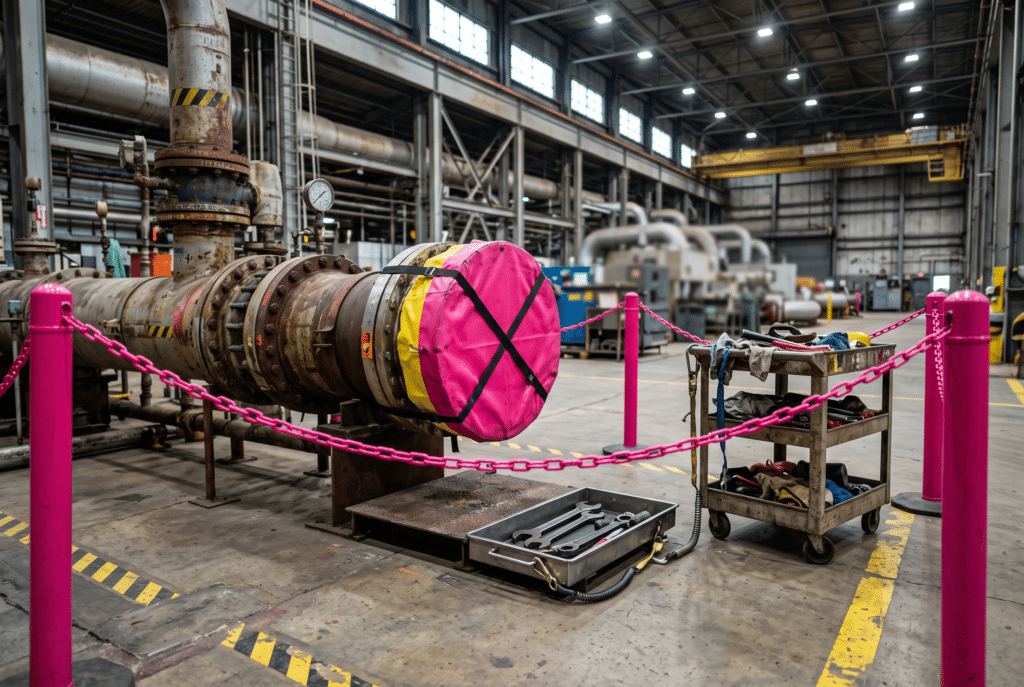
The principle is simple: whatever goes into an FME zone must come out. Applying it is much harder, especially during an outage, when hundreds of workers from several companies take turns on the job. This guide covers FME risk, FME zones, the rules that apply to tools, and how RFID traceability makes the tool inventory reliable.
Key takeaways
- FME = Foreign Material Exclusion: preventing any foreign object from entering an open circuit or component. It is the nuclear and energy counterpart of FOD in aviation.
- An FME zone is bounded and marked, often in magenta, with restricted access and control of everything that goes in and out.
- Tools must be logged in and out. This is the weakest step when it relies on a paper log.
- RFID makes this inventory automatic: every tool is identified, every entry and exit is time-stamped, and any discrepancy is flagged before the zone is closed.
Contents
- What is foreign material exclusion?
- Where does foreign material come from?
- Why FME risk is costly
- The framework: operator, regulator and contractors
- The FME zone: boundaries, marking, rules
- Tools, the weak link of FME
- Making the FME inventory reliable with RFID
- Setting up FME tool traceability
- Frequently asked questions
What is foreign material exclusion?
Foreign material exclusion covers every measure that prevents an object, debris or substance from being accidentally introduced into a sensitive installation. The FME risk is the risk that it gets in anyway.
The term is mainly used in nuclear power and energy: power plants, naval propulsion and nuclear facilities, but also chemicals, petrochemicals and heavy equipment manufacturing. The French nuclear industry also speaks of migrating bodies (corps migrants): an object introduced into a circuit and carried by the fluid to a place where it causes damage.
FME or FOD? The two ideas are close. FOD (Foreign Object Debris or Damage) comes from aviation and refers to the foreign object and the damage it causes. FME describes the preventive approach: doing everything so that the object never gets in.
Where does foreign material come from?
| Source | Examples | Countermeasure |
|---|---|---|
| Tools | Wrench, socket, bit, flashlight, mirror, tape measure | Tethered tools, log in and log out |
| Fasteners and removed parts | Screws, nuts, washers, gaskets, pins | Dedicated trays, counting, storage away from the opening |
| Consumables | Rags, tape, gloves, packaging, bags | Counted consumables, closed bins |
| Work debris | Chips, filings, grinding or welding residue | Covering openings, vacuuming, inspection |
| Personal items | Pen, badge, glasses, phone | Access rules, closed pockets |
Tools stand apart: they are the most handled items, the most shared between workers, and the only ones that can be tracked individually, tool by tool.
Why FME risk is costly
A foreign object in a circuit can jam a valve, damage a pump, a heat exchanger or a seal, or impair safety equipment. Even before any damage, the mere suspicion has a cost: the object must be searched for, sometimes by disassembling or by camera inspection, and the return to service waits.
On a nuclear unit, every extra day of outage means lost generation. This is why FME is treated as both a safety and an availability issue, and why a tool that cannot be found at the end of a job can hold up an entire worksite.
In an FME zone, the question is not whether the rules exist. It is whether you can prove, at closeout, that everything that went in came back out.
The framework: operator, regulator and contractors
In France, the nuclear operator governs FME through its own standards and procedures, which apply to its staff and to every contractor working on its sites. The nuclear safety regulator checks how they are applied during inspections: conditions for entering and working in an FME zone, means of preventing and detecting migrating bodies, and the inventory of equipment brought into the zone.
Inspection follow-up letters published by the regulator point out deviations on this last point: an incomplete inventory of equipment and tools brought in makes it impossible to control the zone effectively. For a contractor, mastering FME is therefore also a condition for working on these sites.
Workers receive FME training before entering the zones concerned. The precise rules (zone levels, log content, closeout checks) depend on the country, the operator and the site: they always take precedence over the general principles described here.
The FME zone: boundaries, marking, rules
An FME zone is set up around any open component where an object could fall or be left behind. It is kept as small as possible and follows a few constant rules:
- Boundaries and marking: chains, posts, tape and signs, usually in magenta (fuchsia pink), the identification color of FME equipment in France.
- Restricted access: only trained and authorized workers enter, and their presence is recorded.
- Covers: openings are protected with plugs, lids or covers as soon as no one is working on them.
- Secured tools: tools tethered with lanyards above an opening, dedicated trays for fasteners and small parts.
- Inventory: every tool or item that goes in is logged and accounted for on the way out.
- Closeout check: before the component is closed, the team verifies that the inventory is reconciled and the inside is clean, often with a second check.
Tools, the weak link of FME
Barriers, covers and lanyards are physical means: once in place, they work. The tool inventory, on the other hand, depends on everyone writing things down and paying attention. That is often where discrepancies appear.
- The paper log is filled in by hand at the zone entrance, sometimes with gloves on, under time pressure.
- Workers take turns: shift teams, different companies, handovers between jobs. A tool brought in by one person may be taken out by another, or not at all.
- The final count compares a written list with trays and boxes. A missing tool is discovered at closeout, when every minute counts.
- The evidence is a paper document, hard to use after a discrepancy or during an inspection.
| Question | Paper log and trays | RFID traceability |
|---|---|---|
| Which tools went in? | Whatever was written down | Read automatically, tool by tool |
| Who brought them in? | If it was noted | Yes, by badge |
| Has everything come out? | Manual count at the end of the job | Discrepancy shown immediately |
| Evidence for inspection | Paper sheets | Time-stamped, exportable history |
| Finding a missing tool | Visual search | Handheld reader that guides you to the nearby tool |
Making the FME inventory reliable with RFID
RFID does not replace barriers, covers or lanyards. It addresses the step that depends most on people: knowing exactly what went in and checking that everything came out.
1. Every tool identified
Each tool receives a UHF RFID tag designed for metal, fitted without affecting the grip. The tag is chosen with the site constraints in mind, such as cleaning or decontamination, and validated on your actual tools. See our RFID labels and tags.
2. Entry and exit read in one move
A set of tools is read in a few seconds, without taking them out one by one: with a handheld RFID reader at the zone entrance, a fixed read point or an RFID gate. Workers identify themselves with their badge, and the log fills itself in.
3. Tools tracked at the workstation
Right next to the open component, an RFID tool cart knows, each time a drawer closes, which tool was taken out, who took it and whether it came back. It tells planned absences (a tool out for calibration or repair) apart from a tool that is actually missing.
4. Discrepancies flagged before closeout
When the zone is closed out, the system compares what came out with what went in. If a tool is missing, the alert is immediate, with the tool and the last worker who handled it. The handheld reader then helps locate it nearby.
5. Usable evidence
Every movement is time-stamped and linked to a worker, a zone and a job. The history can be exported for the job file or an inspection, and the data can be hosted on site, in line with the operator’s IT policy.
The CIPAM solution
Paperless FME tool inventory
An RFID integrator for more than 30 years, CIPAM has designed an RFID tool cart whose first production run is underway for a major international energy company. We combine it with mobile detection and read points suited to your zones.
- RFID tool cart: drawer-by-drawer tool control, right next to the job.
- Mobile detection: inventory of a toolbox or a zone in seconds, guided search for a tool.
- RFID tags for metal, chosen tool by tool.
- Software: automatic log in and log out, alerts, exportable history, on-site or cloud hosting.
Setting up FME tool traceability
- Choose a typical job: a recurring activity, with known tooling and frequent FME zones.
- Qualify the tools: which tools to track individually, which to manage as counted kits, which tag for each.
- Define the read points: zone entrance, workstation, tool crib, as close as possible to real practice.
- Align the rules with your FME procedures: log content, alerts, closeout conditions.
- Validate in real conditions, then extend to other jobs and to contractors.
Frequently asked questions
What does FME stand for?
FME stands for Foreign Material Exclusion. It is the set of rules and means that prevent an object or debris from being accidentally introduced into an open circuit or component, especially in nuclear power and energy.
What is the difference between FME and FOD?
FOD comes from aviation and refers to the foreign object and the damage it causes. FME is the nuclear and energy term, focused on prevention. Both rest on the same principle: whatever goes in must come out.
What is an FME zone?
A bounded area around an open component, usually marked in magenta, with restricted access, where everything that goes in is controlled and logged, and where openings are covered as soon as no one is working on them.
Do tools have to be logged in an FME zone?
Yes. The principle is to log every tool and item that enters the zone and to check that it has come out before closeout. The exact requirements depend on the operator’s and the site’s procedures.
Does RFID replace lanyards and covers?
No. Lanyards, trays and covers stop the object from falling or getting in. RFID makes the inventory reliable: it records what went in and what came out, and flags the discrepancy.
Can tools from several companies be tracked on the same job?
Yes. Each worker identifies with a badge and each tool carries its own identifier. The history shows who brought each tool in and out, whatever their company.
Can the data stay on site?
Yes. The software can be hosted on site or on your own servers, without relying on an external cloud, in line with your IT policy.
Can we start with a single job?
Yes, and it is the recommended approach: one typical job, one set of tools and one read point are enough to validate the approach before extending it.
Further reading
See also: the RFID tool cart, FOD prevention in aviation, the shadow board guide and RFID tool tracking.
Let’s talk about your FME work
Which jobs, which tools, which inventory requirements? Tell us how you are organized and we will propose a first pilot scenario.