


RFID-Enabled Tool Cart: Every Tool Tracked, No Tool Left Behind
Is a tool missing at the end of a job, forcing the entire team to search for it before the equipment can be put back into service?
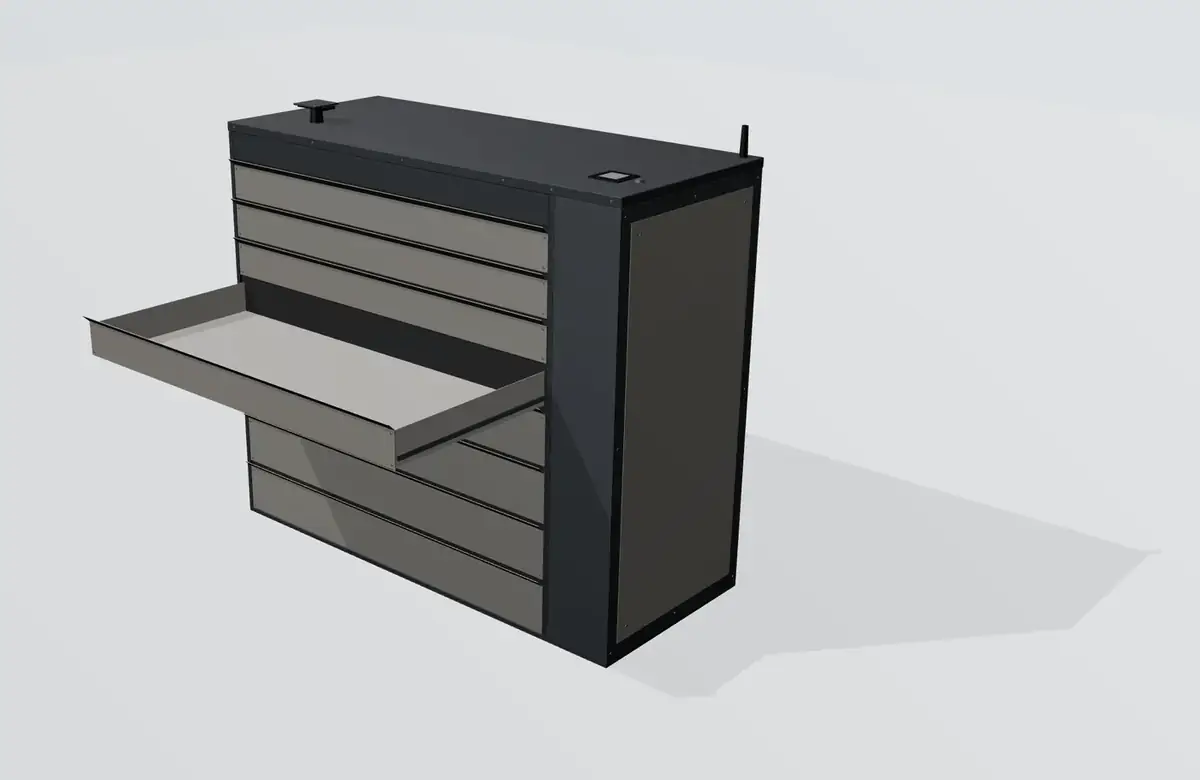
CIPAM has designed an RFID tool cart for maintenance and assembly shops: it knows which tool has been removed, who took it, and whether it has been returned. Every time a drawer is closed, it takes inventory and flags the missing tool before it becomes a FOD hazard.
Visual and paperwork inspection
- Cut foam checked by eye at the end of the shift
- Tool checkout forms filled out by hand, or not at all
- Missing tool discovered too late, after the equipment has been closed
Automatic inventory
- Each drawer is automatically monitored when closed
- Every tool taken out is linked to a badge
- A missing tool is reported immediately, along with the name of the last person who took it
Guided Search
- An RFID terminal guides you to the tool you’re looking for
- Checking an area before putting it back into service
- Inventory a toolbox or a cart in just a few seconds
Forgotten, lost, or missing tools: the cost of poor tool management
In a maintenance or assembly shop, hundreds of tools change hands every day, moving between teams and workstations. As long as tracking them relies on the operator’s attention, three things inevitably happen: a tool gets left inside a piece of equipment, a tool goes missing, or a tool is missing when it needs to be presented during an audit.
The problem isn’t the teams’ diligence. It stems from the volume of work, tight deadlines, and staff turnover: the more equipment is shared, the less reliable visual inspections become. The consequences, however, are very real.
FOD Risk
A wrench left behind in an engine, a turbine, or a landing gear becomes a foreign object: causing damage, groundings, and safety risks. This is known as FOD (Foreign Object Damage). The EN 9146 standard requires manufacturers in the aerospace and defense industries to implement a FOD prevention program, and Part-145 maintenance facilities must ensure that no tools are left in the work area after a job. The nuclear industry applies the same principle under the name FME (Foreign Material Exclusion).
Losses and Theft
Torque wrenches, metrology instruments, specialized tools: shared tools are the most at risk. A missing tool costs more than just the price of a replacement. One manufacturer interviewed for our study had metrology instruments go missing: production shutdown, audit non-compliance, and approximately €10,000 in losses.
Time Spent Searching for Tools and Taking Inventory
Searching for a tool, counting drawers at the beginning and end of a shift, filling out tool checkout forms: this routine repeats itself every day for every technician. Many workshops eventually stop taking inventory due to lack of time and discover shortages at the worst possible moment.
Compliance and Audits
Clients in the aerospace, defense, and nuclear industries require proof of who used which tool, when, and whether it was properly calibrated. Without a reliable history, each audit must be prepared manually using incomplete records.
Shadow board, badge-operated cart, or RFID cart: what each solution controls
Die-cut foam panels (shadow boards) make missing items visible—but only if someone looks. The badge-operated cart controls access, not the contents. The RFID cart controls both—tool by tool—without requiring any additional action from the operator.
| What is controlled | Foam and cards | Badge-operated cart | CIPAM RFID cart |
|---|---|---|---|
| Who opens the cart | No | Yes | Yes |
| Which tool was taken out | By eye | No | Yes, automatically |
| Missing tool before return to service | If anyone checks | No | Immediate alert |
| Inventory | Manual | Manual | Every time a drawer is closed |
| Audit History | Paper records | Openings only | Each tool movement |
| Find a tool that has been removed | No | No | Yes, with mobile detection |
Do you recognize your workshop? Describe your tools to us, and we’ll tell you what the RFID cart can monitor in your facility.
Where the RFID cart makes a difference
Anywhere where a forgotten tool is costly, where tools are shared among teams, and where you need to prove what work has been done.
Aviation Maintenance and MRO
Before closing an engine cowling or signing off on a return to service, the mechanic must be certain that all of his tools have been returned. In a Part-145 facility, this check is part of the FOD prevention program and must be verifiable.
The tool cart: checks each drawer as it closes, alerts the mechanic if a tool is missing before signing off, and the mobile terminal scans the area in case of doubt.
Assembly of turbines and heavy equipment
Projects last for weeks, teams work in 2×8 or 3×8 shifts, and tools are passed from one person to another. The risk is greatest during shift changes and when equipment is shut down.
The tool cart: takes inventory at each shift change without counting, maintains a record by shift, and flags any tools not returned before shutdown.
Nuclear: Unit Shutdowns and FME Zones
Any tool brought into a foreign material exclusion zone must be removed, and every movement must be tracked. During a shutdown, there are many workers on site, often from multiple companies.
The cart: records every tool entry and exit, with a timestamp and the user’s name; these movements can be linked to work orders in your CMMS.
Military Equipment Maintenance and Defense
Defense workshops combine FOD requirements, strict access control, and data confidentiality. Tools must be tracked without data leaving the site.
The platform: manages access rights by role and by team, and operates with on-site hosting, without relying on an external cloud.
Railway and Maintenance Depots
In a depot, tools are shared among numerous shift teams. Losses, theft, and the time spent searching for a tool all impact the availability of rolling stock.
The tool cart: tracks each tool checkout via ID badge, and the mobile scanner takes inventory of the tool storage area in just a few minutes.
Calibrated metrology tools
Torque wrenches, measuring instruments: Each tool has a calibration date and must be located at the right time. A missing instrument halts production and results in an audit nonconformity.
The tool cart: knows where each instrument is located, and a supervisor marks the tool as being in for calibration to ensure the inventory remains accurate.
A Work Cycle, from Check-In to Return to Service
The tools are equipped with metal-compatible RFID tags. Antennas located under the foam padding in each drawer detect their presence.
1
Badge
The operator logs in at the cart. Their access rights determine which drawers they can open.
2
Tool retrieval
The operator retrieves their tools as usual, without any additional steps or scans.
3
Inventory
When the drawer closes, the cart reads its contents and records each tool taken out, with the time and the user.
4
Return and Alert
Returns are automatically recognized. A tool not returned by the deadline triggers an alert.
RFID Tool Cart: How Does Tool-by-Tool Detection Work
Each tool is equipped with a passive, battery-free UHF RFID tag that carries a unique identifier. The tag is selected based on the tool: miniature and ruggedized for a wrench or pliers, an adhesive label for a toolbox, or a flexible tag for a cable or hose. It is read contactlessly and remains invisible, even when embedded in foam.
Inside the tool cart, antennas located under the foam padding in each drawer read short-range tags. Each time the cart is closed, it checks its drawers, compares their contents to the expected list, and updates the status of each tool. The operator doesn’t have to scan anything: they simply take out and put away their tools as usual.
Metal interferes with RFID reading. That is why the design of the drawers, the placement of the antennas, and the selection of tags are all carefully considered together by a team that has been designing industrial RFID solutions for over 30 years.
Unlike a smart cabinet or a badge-operated locker, which control access to a compartment, the RFID tool cart identifies each tool individually. It answers the three key questions of tool management: Which tool? Who took it? And has it been returned?
This is automated tool control, applied tool by tool and without any action from the operator. The history of every movement provides full tool traceability, from the shop floor to the audit.
What the cart does, as standard
Inventories
At each closing, on demand, or at adjustable intervals—without manual counting.
Qualified Absences
Calibration, repair, loan: a manager reports the absence, and the inventory remains accurate, without false alarms.
Lock-out after a deadline
If a tool is not returned on time, the tool cart may lock until the issue is resolved.
Badges, roles and teams
Everyone has their rights. It also works without a badge, with open access.
Touch screen
A terminal on the cart for the operator; administration protected by badge and PIN code.
History and exports
Movements by tool, by cart and by user, exportable to Excel for your quality audits.
Standard
The Standalone Tool Cart
For a workshop that wants to secure its tools, workstation by workstation.
- All of the above features on every cart
- Alerts sent to your CMMS, ticketing system, or email
- Connection to your information system via API and MQTT
Option
The Coordinated Fleet
For multiple workbenches, multiple workshops, or multiple locations.
- Consolidated view of all workstations
- Users and permissions managed once
- Remote settings and scheduled absences
- Tracking a tool as it moves from one cart to another
- A single point of connection to your IT system
How the RFID Cart Is Transforming Your Workshop
Safety
No equipment is closed up with a tool missing without anyone knowing. FOD checks no longer depend on the vigilance of a single operator at the end of a shift.
Time
No more counting drawers at each shift change, no more checkout forms. When a tool is missing, we know who last used it, and the mobile terminal helps locate it.
Costs
Every checkout is linked to a person, so tools come back. Fewer losses, fewer emergency replacements, fewer stoppages due to lack of tools.
Compliance
A complete history of movements, by tool and by user, ready for your quality audits and for the requirements of your clients.
Adoption
Operators retain their usual procedures: badge, tool retrieval, drawer closure. No scanning, no data entry, no additional constraints.
Integration
Alerts and activity reports are sent to your CMMS, ticketing system, or email. The system integrates seamlessly into your existing processes.
The first demonstrations are coming very soon. Reserve yours today—with a configuration tailored to your tools.
Not all tools are stored in a tool cart
Our tool detection app runs on an RFID mobile terminal such as the Zebra TC22R. It can be used on its own or with the connected tool cart.
The device reads dozens of tags in a second, without needing to aim: taking an RFID inventory of a toolbox, a cart, or a tool storage area takes just a few seconds. For inventory and asset tracking, check out our Inventario inventory software as well.
- Searching for a tool. Like a Geiger counter, the terminal guides the operator toward the tool as he or she approaches it.
- Check before return to service. Verify that no tools have been left in the work area or inside the equipment.
- Inventory of a container. A crate, cart, shelf, or area—in just a few seconds and without opening every box.
- Tools outside the tool cart. Large tools and shared equipment are tracked using the same tags and the same history.
From analyzing your equipment to commissioning
Every workshop has its own tools and procedures. We start with yours—not from a catalog.
1
Tool Inventory Analysis
We review your tools one by one: material, size, use, tools to track, and tools to organize into a toolbox.
2
Configuration
Number and size of drawers, foam inserts, choice of labels, options: we’ll recommend the configuration best suited to your workstation.
3
Settings
Tag placement, tool registration, user permissions, return deadlines, alerts, and integration with your information system.
4
Commissioning
Installation, training for operators and managers, followed by monitoring and maintenance by CIPAM teams.
A cart designed by an RFID integrator
CIPAM has been designing and integrating RFID traceability solutions for over 30 years: tags, readers, antennas, software, and integration with your information system.
A modular line
From compact tool carts to custom models, with drawers in various sizes to fit your tools.
Software tailored to your rules
A standard foundation, then your business rules: deadlines, permissions, alerts, and integration with your tools.
Your choice of hosting
On-premises, on your own server, or in the CIPAM cloud, depending on your IT policy.
Learn more: RFID tool tracking and management, industrial asset tracking, and FOD prevention in the aerospace industry, and foreign material exclusion (FME) in nuclear plants.
FAQ
Frequently Asked Questions About the RFID Tool Cart
What is an RFID tool cart?
It is a workshop tool cart in which each tool is equipped with an RFID tag and the drawers are fitted with antennas. It constantly tracks which tools are present, which have been removed, and by whom, and alerts users to missing tools. It is also referred to as a connected tool cart or a tool management cart.
What is the difference between an RFID-enabled tool cabinet and a badge-operated tool cabinet?
A badge-operated tool cabinet controls who can open the drawers. An RFID-enabled tool cabinet also detects which tools have been removed, by whom, and when. It alerts the user to a missing tool rather than simply locking access.
How can FOD be prevented in a maintenance workshop?
FOD prevention relies on a program (training, clean work areas, tool inspection) as described in the EN 9146 standard. The most challenging aspect is ensuring that no tools are left inside the equipment: the RFID tool cart automatically checks for this every time a drawer is closed, and mobile detection allows the area to be inspected before the equipment is put back into service.
What is the difference between an RFID tool cart and a smart cabinet?
A smart cabinet or locker controls access to a compartment. An RFID tool cart identifies each tool individually, in drawers designed for hand tools, located as close as possible to the workstation.
Can all tools be tracked using RFID?
The vast majority can, using UHF RFID tags designed for metal: miniature ruggedized tags, adhesive labels, or flexible tags, depending on the tool. Very small tools (sockets, bits) are managed in pre-counted kits. We assess your entire tool inventory, tool by tool, before proposing a configuration.
Do operators need to change their routines?
Hardly at all. They badge in, take and put back their tools as usual, and close the drawer. There’s nothing to scan or enter—the inventory is done automatically.
What happens when a tool is sent for calibration?
A supervisor records the absence on the tool cart. The tool becomes a “controlled absence”: the inventory stays accurate and no false alert is raised.
Do I need both the tool cart and mobile detection?
No. The tool cart secures the workstation; mobile detection is used for inventories and to locate a tool that is not in its designated spot. They can be used separately or together.
Does the solution integrate with our tools (CMMS, ERP, metrology)?
Yes. Tool movements can be exported to Excel and sent to your applications via API, MQTT, or automatic alerts to your CMMS, ticketing system, or email.
Where is the data stored?
You can choose: on-premises, on your own server, or in the CIPAM cloud, depending on your IT policy.
How much does an RFID tool cart cost?
The price depends on the number of drawers, the number of tools to be tracked, the tags, and the software options. We’ll provide a quote after analyzing your tool inventory to ensure a configuration that meets your actual needs.
When will the tool cart be available?
The first batch is currently in production, and the first demonstrations will be available very soon. Let’s discuss your needs now so we can prepare a demonstration tailored to your tools.
Let’s Talk About Your Tool Inventory
Tell us how your tools are organized and what costs you money today: foreign object debris (FOD), losses, inventory time, and audits. A CIPAM expert will contact you and introduce you to the tool cart right from the first demonstrations.
- Tool-by-tool analysis of your tools
- Selection of tags and cart configuration
- Tool cart, mobile detection, and software all in one package
- Integration with your information system