


Shadow Board: A Guide to Tool Shadow Boards
By Jean-Luc Boffety, RFID engineer at CIPAM, 28 years of experience
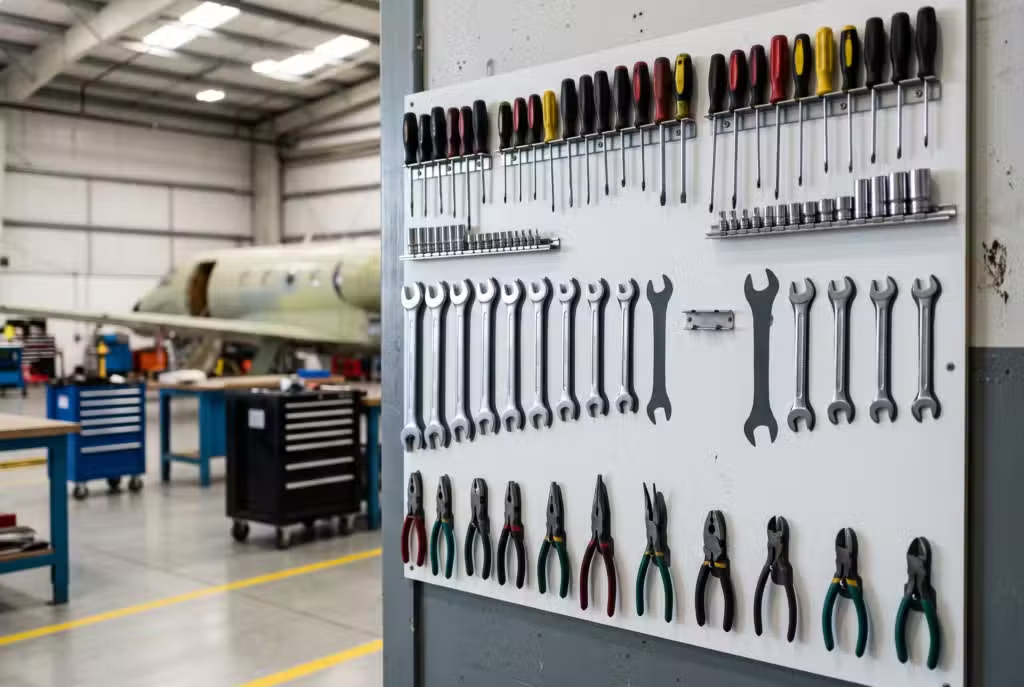
A shadow board is a storage board on which every tool has a place drawn to its shape: its outline, its “shadow”. When the tool is missing, the shadow shows. At a glance, the operator sees what is gone. It is one of the simplest visual management tools, and one of the most widely used in 5S, FOD prevention and food hygiene.
This guide explains what a shadow board is for, how to set one up, the mistakes that make it useless, and its limits, especially when you need to prove that no tool was left in a sensitive area.
Not to be confused with a “shadow board” in corporate governance, a group of young employees advising management. This guide is about tools.
Key points
- One place per tool, shaped like the tool: an absence shows without counting.
- Two formats: the wall-mounted board and cut foam in tool cart drawers.
- It shows that a tool is missing, not who took it or when, and it leaves no record.
- RFID keeps the same habit and adds proof: the connected tool cart detects the missing tool and records every movement.
Contents
- What is a shadow board?
- What is a shadow board for?
- Wall board or cut foam: the formats
- Setting up a shadow board in 7 steps
- Mistakes that make a shadow board useless
- Shadow boards and FOD prevention
- The limits of a shadow board
- From shadow board to RFID tool control
- Frequently asked questions
What is a shadow board?
A shadow board, also called a tool shadow board or tool outline board, rests on one principle: a place for everything, and everything in its place. The tool’s shape is painted, printed or cut out on the board, often in a contrasting color. An empty spot is visible immediately.
The shadow board applies the second S of the 5S method, Seiton (set in order). It is found in maintenance shops, production lines, laboratories, commercial kitchens and cleaning areas subject to HACCP.
What is a shadow board for?
- Save time: the tool is always in the same place, nobody searches for it.
- See absences: a missing tool is spotted without an inventory.
- Standardize the workstation: every team finds the same kit in the same place, whatever the station or shift.
- Build accountability: putting the tool back becomes a habit everyone can see.
- Prevent FOD: before closing an area, you check that every shadow is covered.
- Separate uses: color coding per area stops tools from being mixed, for example between clean and dirty zones in food processing.
Wall board or cut foam: the formats
The wall-mounted board
The best-known format: a board fixed to a wall or a cart, with hooks or holders and outlines. It suits large tools and shared workstation kits. Common materials are rigid PVC, aluminum composite, acrylic or perforated steel, chosen for durability and easy cleaning.
Cut foam in drawers
In tool carts and toolboxes, the equivalent of the shadow board is foam cut to the outline of each tool. Two-color foam is the most common in aviation: a dark top layer and a bright bottom layer. When a tool is removed, the bottom color shows and flags the absence. Foam can be cut by hand, by waterjet or by CNC from a photo of the drawer.
The job kit
A case dedicated to one task, with cut foam and a contents list. The check is done when the kit is opened and closed.
Setting up a shadow board in 7 steps
- Sort. Start from the tasks actually done at the station and keep only the useful tools. An overloaded shadow board becomes unreadable.
- Define the standard kit with the users: which tools, how many, for which station.
- Plan the layout by frequency of use: the most used tools within easy reach and closest to the task.
- Draw or cut the outlines, in a contrasting color or with two-color foam.
- Label each location: tool name or reference, and station or area identification on the board.
- Set the usage rule: who checks, when (start and end of shift, before closing an area), and what to do when a shadow is uncovered.
- Audit regularly as part of 5S audits, and update the kit when tasks change.
Mistakes that make a shadow board useless
- The showcase board: neat on installation day, never checked afterwards.
- Too many tools: shadows blur together and absences no longer show.
- No rule for normal absences: a tool away at calibration leaves an uncovered shadow for weeks, and eventually nobody sees it anymore.
- No owner: when everyone is responsible, nobody reacts to an empty shadow.
- A frozen kit: the station changes, the board does not, and operators store tools elsewhere.
Shadow boards and FOD prevention
In aviation, shadow boards and two-color foam are the foundation of FOD tool control. Before closing a panel, a cowling or an area, the operator checks that every shadow in the tool cart is covered. If one is missing, the area stays open until the tool is found.
This visual check is often backed by tool tags or loan cards for tools taken from the tool crib, and by a double check before closing critical areas. It works well as long as tool carts are few, teams are stable and rates are under control.
The limits of a shadow board
A shadow board answers one question only: is a tool missing here? It does not answer the next ones.
- Who took the tool, and since when? The shadow does not say.
- Is the absence normal? A tool at calibration and a tool forgotten in an engine leave the same shadow.
- Was the check actually done? Nothing records it. In an audit, you have to take it on trust or write it down by hand.
- Is the right tool in the right place? A tool of the same shape stored in another cart goes unnoticed.
- And at scale? Across dozens of tool carts and several teams, the visual check depends on everyone’s vigilance, and vigilance fades at the end of a shift.
From shadow board to RFID tool control
RFID does not replace the shadow board: it makes it speak. Each tool receives a small RFID tag designed for metal. The foam and outlines stay, the operator’s habit does not change, but the storage itself now knows what it contains.
In a connected RFID tool cart, antennas under the foam of each drawer read the tools every time the drawer closes. The cart knows which tool is missing, who took it thanks to the operator’s badge, whether it came back, and whether its absence is planned (calibration, repair, loan) or not. Every movement is time-stamped and can be exported for audits.
| Question | Shadow board | Connected RFID tool cart |
|---|---|---|
| Is a tool missing? | Yes, if someone looks | Yes, at every closing, with no action |
| Who took it? | No | Yes, by badge |
| Planned or abnormal absence? | No | Yes, qualified absences |
| Proof of the check | None, or manual entry | Time-stamped, exportable history |
| Alert | No | Yes, missing or unreturned tool |
For tools that are not stored in a cart, a mobile RFID terminal lets you inventory an area or find a nearby tool. For an overview of the topic, see our page on RFID tool tracking.
The CIPAM solution
Keep the foam, add detection
CIPAM has designed an RFID tool cart that keeps the shadow board principle and adds tool-by-tool detection, user identification and history. As an RFID integrator for more than 30 years, we choose the right tag for each tool and the antenna layout with you.
Frequently asked questions
What is a shadow board?
A board or storage support where every tool has a place drawn to its shape. When the tool is missing, its outline appears, so you can see at a glance what is gone.
What is the link between shadow boards and 5S?
The shadow board applies the second S, Seiton: store everything in a defined, visible place. It also supports the fifth S, Shitsuke, by making deviations visible during audits.
Why use two-color foam?
The bright bottom layer shows as soon as a tool is removed. The absence is more visible than with single-color foam, which speeds up the check before closing an area.
Is a shadow board enough for FOD prevention?
It is the foundation, but it does not show who took a tool or when, and it leaves no record of the check. When you need to prove tool control in an audit, or manage many tool carts, you add traceability, for example RFID.
Can a shadow board be connected?
Yes. By fitting tools with RFID tags and drawers with antennas, the tool cart detects present and missing tools itself, identifies the user and records every movement, without changing the operator’s habit.
Further reading
See also: the RFID tool cart, FOD prevention in aviation, RFID tool tracking and our mobile inventory terminals.
Let’s talk about your shop
How many tool carts, which tools, what traceability requirements? Tell us how you work and we will propose the right solution.