



Staff Location in Sensitive Areas: Safety and ATEX/SEVESO Compliance
Consider an evacuation drill at a SEVESO-designated site. The siren sounds, everyone heads to the assembly point, and a supervisor checks names off a sheet.
Then comes the chilling question. Are you sure? How long does it take you to say, without the slightest hesitation, that no one stayed inside?
At a high-risk site, this uncertainty isn’t just a management inconvenience. It’s a security flaw and a compliance violation that could prove very costly once it’s discovered.

The Essentials
- Three obligations, one answer. Know who is present and where, and then be able to evacuate while keeping an accurate record of who is present and who is missing.
- In explosive areas, the badge must be ATEX-certified. This is a safety requirement, not an option.
- Lone workers are protected by a badge equipped with an SOS function and a tilt sensor, which triggers an automatic alert.
- The evacuation headcount is now automated and can be transmitted to emergency responders in a matter of seconds.
What the Regulations Really Require
ATEX and SEVESO sites require knowing who is present and where, and then being able to respond immediately. Specifically, this involves three capabilities: continuously identifying people on site, locating them in critical areas, and initiating an evacuation while keeping an accurate record of who is present and who is missing.
There is an additional obligation specific to workers who work alone. The employer must be able to alert others and provide assistance to a person who is working alone, out of sight and out of earshot. At a high-risk site, this obligation cannot be met simply by having a phone in one’s pocket.
Paper-based time tracking fails to deliver on any of these promises when it matters most. It tells you who clocked in that morning, not who is in the building when the alarm sounds.
The ATEX label: a detail that’s anything but
In explosive atmospheres, ordinary electronic equipment poses a risk in and of itself: a single spark is all it takes. That is why, in ATEX zones, the badge or tag worn by personnel must be certified as intrinsically safe—designed to never become a source of ignition.
The certification level depends on the zone: zones where an explosive atmosphere is present at all times do not have the same requirements as those where it occurs only occasionally. Selecting the right equipment for the right zone is just as much a part of the project as location accuracy. This is a point on which we make no compromises, as it involves the safety of our teams.
Making one’s presence felt, without even thinking about it
Staff members wear a long-range RFID badge or an RTLS tag, depending on the level of accuracy required. Data is collected automatically by terminals, gates, and readers located throughout the site. No action is required on the part of the staff. This is precisely what makes the data reliable: it does not depend on individual vigilance.
The choice of technology is not insignificant; we discuss this in detail in our RTLS vs. RFID comparison. UHF RFID is sufficient for zone-based presence monitoring: who has entered, who has exited, and who is currently in the area. RTLS, whether using UWB or BLE, provides continuous and more precise location tracking, which is useful when you need to monitor a worker in real time within a hazardous area. Those present are then displayed on a site map, along with their movement history and an alert if someone crosses the boundary of a restricted area.
It follows the same logic of real-time tracking as that used for assets, but this time applied to people, with the associated security and privacy requirements.
Protecting Workers Who Work Alone
This is often the feature that gives high-risk teams the greatest peace of mind. The badge can trigger a manual SOS with a single press, as well as an automatic alert if the wearer loses their upright position or remains motionless for an extended period—two signs of distress or a fall.
The alert is immediately relayed to supervisors, along with the person’s last known location. Emergency responders don’t waste time searching—they know exactly where to go. On a large site or during staggered shifts, this capability changes the very nature of working alone, which is no longer a matter of chance.
Evacuation: Count in seconds, not minutes
During an evacuation, the system tracks in real time who has reached the assembly point and who is still missing. Headcounts are no longer just a hastily scribbled list. They become reliable information, available in a matter of seconds and ready to be relayed to emergency responders.
On the day it really counts, you won’t have time to count. The system has already done it.
The CIPAM Solution
A security system designed for your historic site
CIPAM designs the entire system—from access badges to monitoring—taking into account your specific areas and regulatory requirements. For over 30 years, we have been integrating hardware, software, and interfaces with your existing systems.
- ATEX-certified, intrinsically safe badges and tags with an SOS function and tilt detection.
- Terminals, gates, and location antennas at entrances and in critical areas: see our readers and antennas.
- Monitoring application with real-time map: presence by zone, zone exit alerts, evacuation headcount, and route history.
- Integration with your supervision system or building management system (BMS) to ensure that personal safety is incorporated into your existing system.
- Compliance support, from selecting ATEX certification to defining the project scope with your HSE teams.
Overcoming Uncertainty About Attendance
We start with your actual areas and security scenarios. Describe your site to us, and we’ll propose an initial pilot scope.
Design My DeviceCompare RTLS and RFID
Case Study: Improving the Reliability of Attendance Tracking at a High-Risk Site
Background
A high-risk industrial site needed to improve the reliability of attendance tracking and ensure the safety of operations in sensitive areas. Evacuation headcounts relied on manual roll calls, which were slow and unreliable at critical moments. Workers operating in isolated areas did not have a reliable alert system.
What CIPAM Has Deployed
Staff were equipped with long-range badges; tracking antennas were installed in critical areas; and attendance data was transmitted to the monitoring center. The badges include a lone-worker alert feature. The system was designed on a zone-by-zone basis, based on the required accuracy and site-specific constraints.
What This Changes
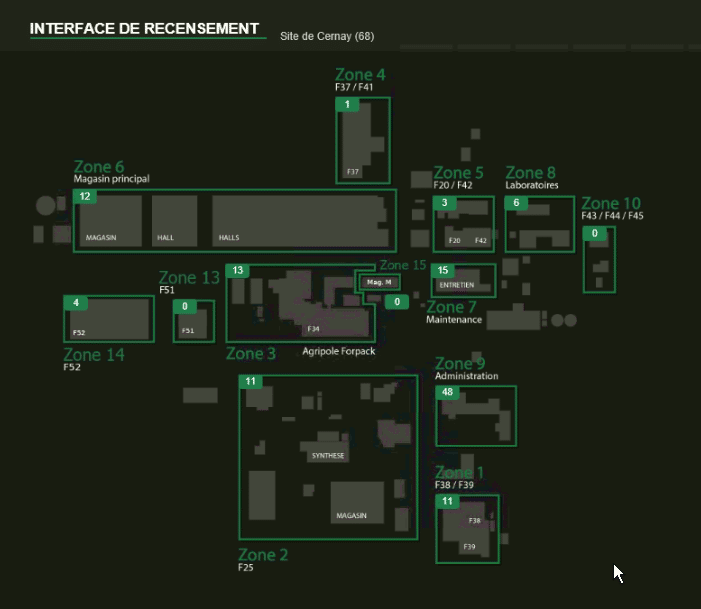
The monitoring system displays who is present in real time, receives an alert when someone enters a sensitive area, and generates an automatic headcount—a process that was previously done manually. The uncertainty of the “D-Day” approach gives way to immediate information.
Locating People Without Compromising Their Rights
Tracking employees is not a trivial matter from a legal standpoint. A system of this kind must serve a clearly defined security purpose, be proportionate, involve informing employees and consulting with employee representatives, and comply with the GDPR’s framework regarding data retention periods.
We design projects with this in mind: tracking is used to ensure safety, not to monitor productivity. This framework is established in advance, in collaboration with your HSE teams and employee representatives. It determines both the acceptance of the system and its legality.
Making Your Project a Success: The Method
A staff location project is built based on your zones and security scenarios, not on a list of equipment.
Map out the zones and their ATEX classifications to select the appropriate certification. Define the required level of accuracy—presence monitoring in some zones, continuous monitoring in others. Select the badges and alert mode for lone workers. Coordinate regulatory compliance with HSE teams and employee representatives. Integrate with the existing monitoring system. Then validate the system in a pilot scope before rolling it out company-wide.
Frequently asked questions
Which technology should be used to track employees: RFID, BLE, or UWB?
UHF RFID is suitable for zone-based presence monitoring. RTLS, whether using BLE or UWB, provides continuous and more precise location tracking. The right choice depends on the level of precision required and the site environment.
Can the badges be used in ATEX zones?
Yes, provided that intrinsically safe certified tags and transponders are used that are appropriate for the zone classification. The choice of certification is an integral part of the project.
Does the program protect independent workers?
Yes, thanks to badges with an SOS function and detection of loss of vertical position or immobility, with automatic alerts sent to the monitoring center and the last known location.
Is tracking employees’ locations legal?
Yes, provided that it serves a security purpose, remains proportionate, includes informing individuals and consulting with employee representatives, and complies with the GDPR. We will work with you to establish the framework for this aspect.
Can we integrate the system with our existing monitoring system?
Yes. Presence and alert events can be forwarded to your monitoring system or building management system, following the same integration approach as our other solutions.
Where should I start?
This involves a critical area and a priority safety scenario—often evacuation or a lone worker situation. The system is validated within this scope before being extended to the entire site.
See also: Tracking and Locating People, Real-Time Asset Geolocation, and the Traceability Glossary.
Let’s talk about your website
Tell us about your facilities, your workforce, and your regulatory requirements. We’ll design a solution tailored to your needs.
hbspt.forms.create({portalId:”142268676″,formId:”7703be11-c760-4836-8c4a-54cd680a95ca”,region:”eu1″});