RTLS or RFID: Which Technology Should Be Used for Real-Time Tracking (UWB, BLE)?
Many location projects start out based on a misunderstanding. People request RFID technology thinking they’ll get real-time location data. Or the opposite: they opt for costly RTLS when a simple scan at the right location would have been enough.
These two families of technologies address different needs. Confusing them almost always leads to a disappointing implementation—one that’s either too expensive or too imprecise. Here’s how to decide between them, without the jargon.
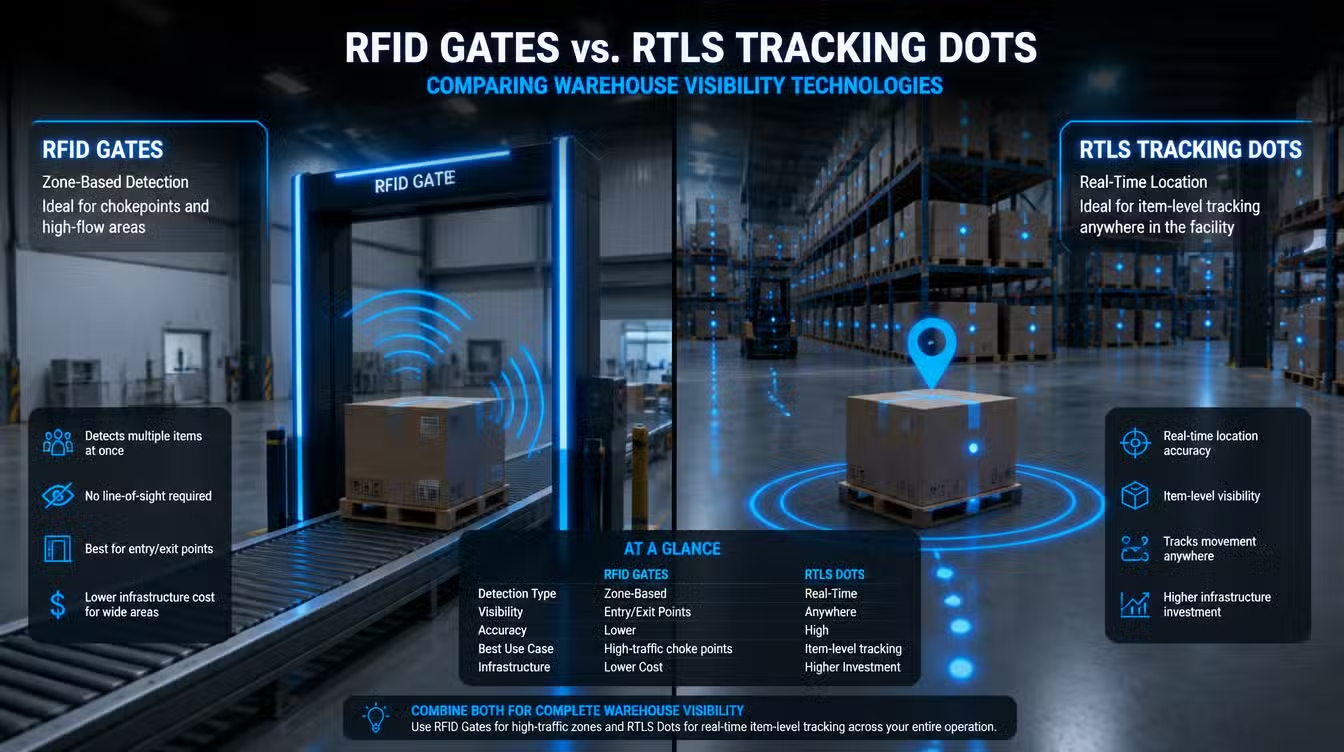
RFID identifies items as they pass through. It says where an object was last seen, not where it is now.
The RTLS continuously tracks locations. It provides real-time location data, using UWB to the centimeter or BLE to the meter.
Precision comes at a price. The finer the resolution, the more expensive the infrastructure and tags become. The right choice is useful precision, not maximum precision.
The two are often used together at the same site—RFID at access points and RTLS in high-value areas.
RFID identifies items as they pass through
UHF RFID identifies an object when it passes through a reading point: a gate, a fixed antenna, or a mobile reader. It excels at flow control, inventory management, and zone-based traceability. Passive tags contain no battery, cost anywhere from a few cents to a few euros, and last for years.
What it doesn’t do: provide a continuous location. It knows where the object was last seen, not where it is at this very moment. For many purposes, knowing that “it entered Zone C at 2:12 p.m.” is more than enough, and it is by far the most cost-effective solution.
The RTLS continuously tracks locations
RTLS, which stands for Real-Time Location System, provides real-time location data through an infrastructure of fixed anchors that continuously calculate the position of an active tag. Since this tag transmits signals, it contains a battery whose life depends on the update frequency. Two technologies dominate indoor applications.
UWB, which stands for Ultra Wide Band, offers accuracy in the range of 10 to 30 centimeters. It’s the go-to solution when you need to locate a specific asset in a large workshop or track a person’s movements indoors with high precision. On the other hand, it requires a higher density of beacons, which means a larger investment.
BLE, short for Bluetooth Low Energy, aims for an accuracy of a few meters, with a lighter infrastructure and beacons that have a very long battery life—capable of lasting several years. It is suitable for large-scale area tracking, when accuracy to the meter is sufficient. For large outdoor sites or tracking across multiple facilities, we move beyond RTLS to GPS or LoRa.
The Comparison, Criterion by Criterion
Criterion
UHF RFID
UWB RTLS
BLE RTLS
What it looks like
Single-point transition
Continuous position
Continuous position
Precision
By area or point
10 to 30 cm
A few meters
Tag
Passive, no battery
Active, battery-powered
Active, long battery life
Infrastructure
Readers at crossings
Dense anchors
Lightweight anchors
Relative Cost
Most economical
Highest
Intermediate
Ideal for
Flow, inventory, and traceability by zone
Locating a specific asset indoors
Large-scale zone tracking
How to Choose: Three Questions to Ask
There’s no need to spend weeks comparing spec sheets. Just three questions are enough to guide almost any project.
Do you need the position at all times, or just at certain points? If you just need a history of entries and exits, RFID is sufficient. If you need to track the asset’s movement on a map, you’ll need RTLS. How much precision is actually useful? In a crowded workshop, even a single centimeter makes all the difference; you don’t need to know which building a cart is in. What is the budget per asset under management? A passive tag costs a few cents, while an active tag costs tens of euros, plus the cost of the infrastructure. The answers to these three questions shape the architecture.
Most often, we combine the two
In practice, RFID and RTLS are not mutually exclusive; they complement each other. RFID covers access points and inventory, while RTLS takes over in the few high-value areas where continuous positioning really matters. All data is fed into the same monitoring tool.
Over-engineering a site with UWB when a single RFID read at the right location would suffice. Maximum accuracy isn’t always the most useful accuracy. A dense network of anchor points entails deployment and maintenance costs that are justified only when necessary.
Our approach is simple: we don’t sell technology; we design an architecture based on what you actually need. This avoids both under-provisioning, which leads to disappointment, and over-investment, which undermines your return on investment.
CIPAM Support
A technology-neutral integrator
CIPAM is an expert in both RFID and RTLS and selects solutions based on your needs, not on a catalog. We design the architecture, supply the hardware, develop the application, and integrate it with your information system.
A monitoring application that combines RFID and RTLS on a single real-time board.
A sizing study to determine the appropriate level of accuracy and control deployment costs.
Track Your Assets and Personnel
We start with your specific needs and your environment—not with a pre-determined technology. Tell us about your project, and we’ll propose the right architecture for you.
UWB for accuracy, ranging from 10 to 30 centimeters. BLE for covering large areas at a lower cost when accuracy on the order of meters is sufficient. The choice depends on the level of accuracy that is actually needed and the budget per asset.
Can I keep my existing RFID system and add RTLS?
Yes. RFID and RTLS are complementary and operate together at the same site, feeding data into the same monitoring system. RTLS is added only where continuous location tracking provides value.
Does the RTLS work outdoors?
RTLS is designed for indoor use, where GPS does not work. For outdoor use or between multiple sites, we rely instead on GPS and LoRa, which we evaluate based on your needs.
Is the advertised accuracy the same as what is achieved in the field?
Actual accuracy depends on the environment: metal structures, anchor density, and obstacles. That is why a serious RTLS project requires an on-site calibration phase, rather than simply reviewing the technical specifications.
How long does the battery in an RTLS beacon last?
From a few months to several years, depending on the technology and update frequency. This frequency is adjusted based on actual needs, since it determines the battery life.